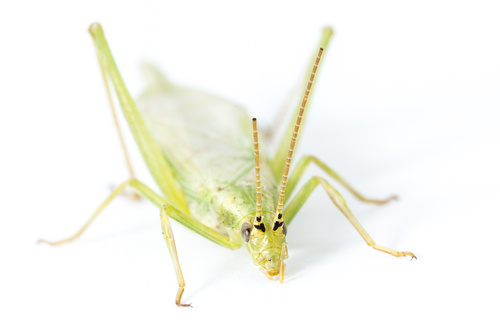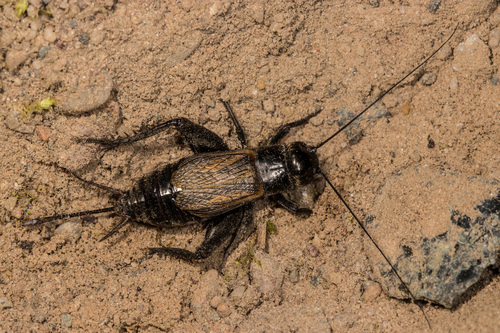
About Gryllus veletis (Alexander & Bigelow, 1960)
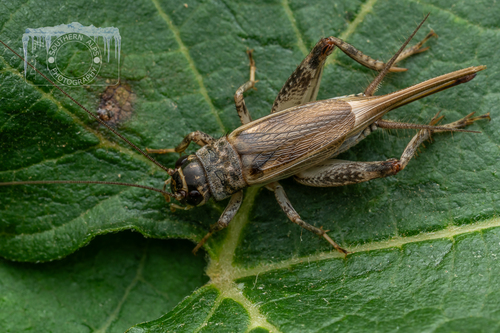
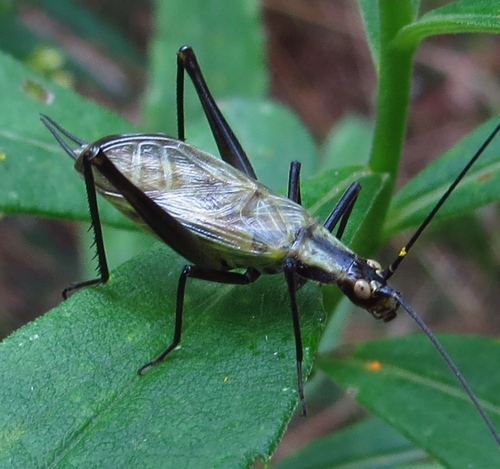
Identification: The adult body length of Gryllus veletis measures approximately 22.0 mm (0.87 inches). Males of this species are black with dark brown or black appendages. Females share a similar overall coloration, and have a dark brown ovipositor that measures approximately 14 mm (0.55 inches). Female coloration differs from males in that females have lighter, more reddish legs. All field cricket species generally look similar, with minor differences in morphological characteristics such as coloration and ovipositor length helping to distinguish species. However, the male's species-specific song also plays an important role in identification. This song also allows individual crickets to distinguish mates and members of their own species from other cricket species that live in the same area. A recording of the spring field cricket's song can be heard here. Distribution: Gryllus veletis is abundant throughout eastern North America. Its range extends from southern Canada to northern Georgia, and reaches as far west as Washington and Oregon. G. veletis occurs in the same geographic areas as G. pennsylvanicus, but the spring field cricket does not extend as far north as Nova Scotia, Canada. G. veletis can be found in disturbed habitats such as old fields and weedy roadsides. Life cycle and mating behaviour: Spring field crickets reach sexual maturity between late May and early August. Males attract sexually receptive females through acoustic signals called stridulation. This process works by rubbing two rigid veins on the wings against each other: one vein is a smooth scraper, and the other is a rough file. To amplify the produced sound, the wings are held at a 45-degree angle above the thorax. Calling activity typically peaks at sunrise, and lasts between 1.3 and 1.8 hours each night. If nighttime temperatures drop below 10 °C (50 °F), however, calling shifts to the daytime. At 29 °C (85 °F), this species produces 120 to 370 chirps per minute, arranged in chirps of 3 to 5 pulses each. When a female is near a male's territory, the male uses a quieter courtship song to lower the risk of predation and avoid attracting competing males. Both males and females have directional hearing. Tympanums on the front legs detect vibrations from chirps. Based on the vibration strength and which leg receives the vibration, the cricket can pinpoint the caller's location. After mating, females use their ovipositor to lay eggs into a soil substrate. Eggs mature between June and September. Immature spring field crickets continue developing into late-instar nymphs, and overwinter in this nymph stage until emerging as adults in late May. G. veletis produces one generation per year.