About Grus vipio Pallas, 1811
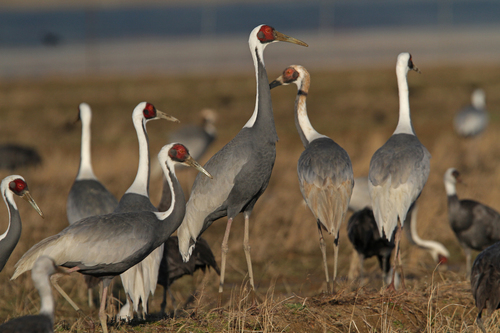
Description: The white-naped crane (Grus vipio Pallas, 1811) can be identified by its grey body, reddish face patch, white throat, and a white stripe that runs from the back of its crown down its neck (the nape). Juvenile white-naped cranes differ from adults, with brown heads and pale throats. Though other species in the same genus share similar characteristics, the white-naped crane can be distinguished by its white nape, a feature that other species in the genus do not have. The white-naped crane produces a range of different calls: a growling contact call, a high-pitched call used at short ranges, and loud calls that differ between males and females. Its loud calls include aggressive guard calls and calls made when it intends to take flight. Distribution and habitat: The white-naped crane breeds in northeastern Mongolia, northeastern China, and adjacent areas of southeastern Russia; a program at Khingan Nature Reserve in this region raises eggs provided by U.S. zoos to boost the species population. Individual white-naped cranes migrate to different winter locations based on where they breed. Western breeding cranes migrate through China to Poyang Lake, while eastern breeding individuals migrate further south through Korea. At least 50% of the global white-naped crane population is found in Mongolia. There are two main wintering populations of this species: one winters near the Yangtze River in China, and the other winters in the Korean Demilitarized Zone, as well as on the island of Kyūshū in Japan. Counts are conducted multiple times each winter to study the cranes' movement patterns. White-naped cranes use shallow wetlands and wet meadows as breeding sites. They are generally found along lake edges and river valleys, and can also occur in mixed forest grasslands or lowlands. When foraging, they use these existing sites, and will also use farmlands for grazing.