About Grus rubicunda (Perry, 1810)
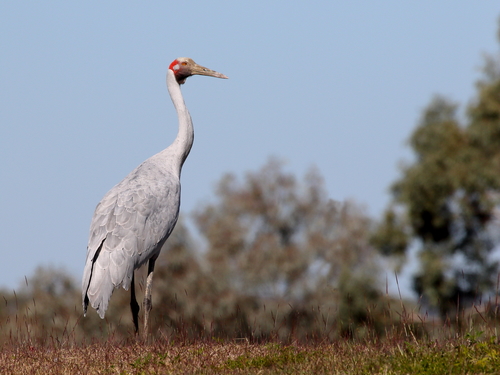
The brolga (scientific name Grus rubicunda (Perry, 1810)) is a tall crane species with a large beak, long slender neck, and stilt-like legs. While males and females look identical to the eye, females are typically slightly smaller than males. Adult brolgas have a grey-green, featherless crown; their face, cheeks, and throat (gular) pouch are also featherless and coloured coral red. The remaining parts of the head are olive green and covered in dark bristles. The gular pouch, which is especially pendulous in adult males, is covered in dense bristles that make it appear black. Adult beaks are long, slender, and greyish-green, and their irises are yellowish-orange. A grey patch of small feathers makes up the ear coverts, which are surrounded by red naked skin, and the brolga's body plumage is silvery-grey. Feathers on the back and wing coverts have pale margins; the primary wing feathers are black, and the secondary wing feathers are grey. The legs and feet of the brolga are greyish-black. Juvenile brolgas do not have the adult red head patch, have fully feathered heads, and have dark irises. A fully grown adult brolga stands 0.7 to 1.4 m (2 ft 4 in to 4 ft 7 in) tall, with a wingspan of 1.7 to 2.4 m (5 ft 7 in to 7 ft 10 in). Adult males have an average body mass of 6.8 kg (15 lb), while females average 5.66 kg (12.5 lb), and body mass overall ranges from 3.6 to 8.7 kg (7.9 to 19.2 lb). Unconfirmed reports note male brolgas reaching heights of up to 1.8 m (5 ft 11 in). The brolga is the heaviest flying bird that regularly occurs on mainland Australia; its average body mass is slightly higher than that of other large resident Australian species including the black swan, Australian pelican, and the Australian population of sarus crane (Asian sarus cranes are taller and heavier). It is also much heavier on average than large flying Australian land birds such as the sexually dimorphic Australian bustard and wedge-tailed eagle, though heavier marine vagrant birds like the wandering albatross may be seen off mainland Australia. Brolgas are likely among the tallest flying birds in Australia, comparable in height to black-necked storks and sarus cranes. Brolgas are easily confused with sarus cranes, but can be distinguished by several traits: sarus cranes' red colouring extends partway down the neck, while the brolga's red colouring is limited to the head; the brolga's plumage is more silvery-grey than the sarus crane's; brolgas have blackish legs rather than the sarus crane's pink legs; and brolga calls are lower-pitched trumpeting and grating sounds. In Australia, sarus cranes are only found in the north-east, while brolgas have a much wider range across the country. Brolgas are widespread and often abundant across northern and north-eastern Australia, particularly in north-east Queensland, and range as far south as Victoria. They also occur in southern New Guinea, and are rare vagrants in New Zealand and northern Western Australia. The northern Australian brolga population is estimated to be between 20,000 and 100,000 individuals, while the southern Australian population numbers around 1,000 individuals. The size of the New Guinea population is unknown. Until sarus cranes were discovered in Queensland in 1961, brolgas were thought to be the only crane species living in Australia. Brolga movement patterns in Australia are not well understood, but seasonal flocks are regularly observed in non-breeding areas of eastern Queensland, and a small number of coastal populations are thought to move up to 500 km (310 mi) inland. Almost nothing is known about the movements and habitat use of New Guinea's brolga populations. Further south, in Victoria and New South Wales, rainfall is evenly distributed through the year, and the driest season runs from December to May. During this dry period, southern brolga populations gather in inland flocking areas, including upland marshes, the edges of reservoirs and lakes, pastures, and agricultural land. When rain arrives in June and July, the populations disperse to coastal freshwater marshes, shallow lakes, wet meadows, and other wetlands to breed. In south-west Victoria, breeding sites during and just after spring are freshwater wetlands, while flocks use freshwater, brackish, and saline wetlands during autumn. Queensland hosts the largest number of brolgas, and flocks of over 1,000 individuals are sometimes seen. The brolga is the official state emblem of Queensland, and appears on the state's coat of arms. Breeding pairs and flocks are spread across multiple floodplains along the Gulf of Carpentaria. Brolgas here prefer two grassland-dominated regional ecosystems (designated 2.3.1 and 2.3.4), though over 30% of the local brolga population share four additional Eucalyptus-dominated woodland regional ecosystems with sarus cranes. Brolga numbers are highest on floodplains dominated by grassland habitats, and the largest flocks are also found in these grassland areas. The social structure of brolga populations is very similar to that of sarus cranes. In breeding areas, breeding pairs defend their territories from other brolgas; if breeding is successful, the pair will stay on their territory with one or two chicks. Nonbreeding birds, which include juvenile birds from previous breeding seasons and adult birds that have not yet established breeding territories, are also present in breeding areas, likely year-round. During the nonbreeding season, brolgas gather in large flocks that appear to be made up of many separate self-contained groups rather than one unified social unit. Within large flocks, individual family groups sometimes stay separate and coordinate their activities only with each other, not the entire flock. On the Gilbert and Flinders river floodplains in south-western Queensland, 26–40% of all crane sightings were of breeding pairs and family groups. Flocks were less common, but 80% of all brolgas counted on the Flinders river floodplain were in flocks. In south-west Victoria, clear distinct breeding (spring) and flocking (autumn) seasons are observed. When taking off from the ground, brolga flight is awkward, with a great deal of wing flapping. The bird's black wingtips are visible while it is in the air, and once it gains speed, its flight becomes much more graceful, and it often ascends to great heights. At these heights, it may be barely visible as it circles in large loops, sometimes giving its hoarse call.