About Grus japonensis (Statius Muller, 1776)
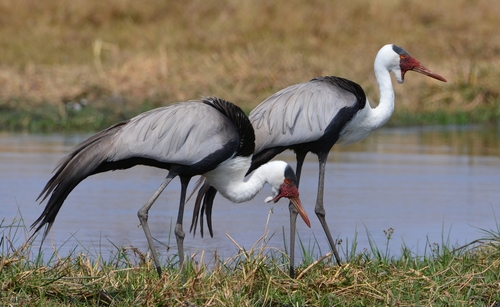
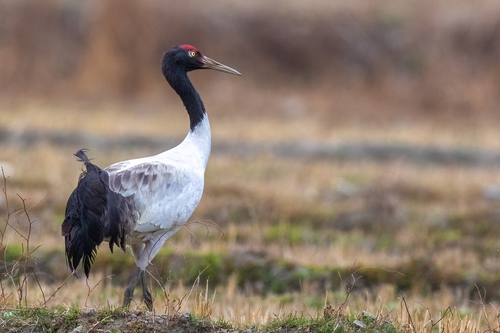
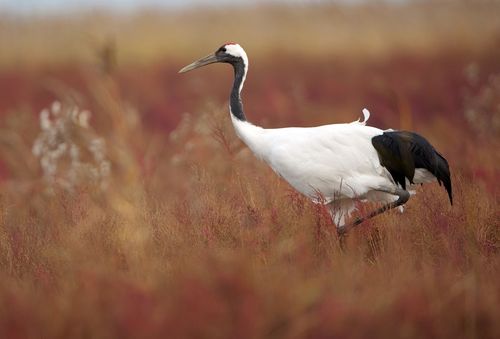
Description: Adult red-crowned cranes (Grus japonensis) get their name from a patch of red bare skin on their crown, which becomes brighter during the mating season. Their body is overall snow white, with black on the secondary wing feathers; when the birds are standing, these black secondaries can look almost like a black tail, but the species' actual tail feathers are white. Males have black coloring on the cheeks, throat, and neck, while females have pearly gray coloring in these same areas. The adult bill ranges from olive green to greenish horn, legs are slate to grayish black, and the iris is dark brown. Juvenile plumage is a mix of white, partially tawny, cinnamon brown, and rusty or grayish. A juvenile's neck collar is grayish to coffee brown, their secondaries are dull black and brown, and their crown and forehead are covered with gray and tawny feathers. Juvenile primaries are white with black tips, and this black tipping also appears on the upper primary coverts. A juvenile's legs and bill are similar in shape to adults, but lighter in color. This species is one of the largest and heaviest cranes. Adults are typically about 150 to 158 cm (4 ft 11 in to 5 ft 2 in) tall, and measure 101.2–150 cm (3 ft 4 in – 4 ft 11 in) in total length from bill tip to tail tip. Their wingspan ranges from 220–250 cm (7 ft 3 in – 8 ft 2 in). Typical adult body weight ranges from 4.8 to 10.5 kg (11 to 23 lb); males are slightly larger and heavier than females, and weights are higher just before migration. On average, the red-crowned crane is the heaviest crane species, though both sarus cranes and wattled cranes can grow taller and have larger linear body measurements than this species. Average weight varies by population: adult males from Hokkaidō weigh around 8.2 kg (18 lb) on average, and adult females there average around 7.3 kg (16 lb). A Russian study recorded an average weight of 10 kg (22 lb) for males and 8.6 kg (19 lb) for females. Despite males having a slightly higher average body weight, some individual females can weigh more than their mates. Another study found the overall average weight for the species to be 8.9 kg (20 lb). The maximum confirmed weight recorded for a red-crowned crane is 15 kg (33 lb 1 oz). For standard body measurements: the wing chord measures 50.2–74 cm (19.8–29.1 in), the exposed culmen measures 13.5–17.7 cm (5.3–7.0 in), tail length is 21.5–30 cm (8.5–11.8 in), and the tarsus measures 23.7–31.9 cm (9.3–12.6 in). Range and habitat: Migratory populations of red-crowned crane breed in spring and summer in far eastern Russia (Siberia), Northeast China, and occasionally in northeastern Mongolia, specifically the Mongol Daguur Strictly Protected Area. The center of the species' breeding range is at Lake Khanka, on the border between China and Russia. In autumn, migratory populations travel in flocks to the Korean Peninsula and east-central China to spend the winter. Vagrants have also been recorded in Taiwan. In addition to migratory groups, a non-migratory resident population lives in eastern Hokkaidō, Japan. This species builds its nests in wetlands, marshes, and along rivers. In their wintering range, their habitat is mainly made up of paddy fields, grassy tidal flats, and mudflats. On these flats, the birds feed on aquatic invertebrates. When conditions are cold and snowy, the birds switch to feeding mainly on leftover rice grains from paddy fields.