About Grindelia nuda Alph.Wood
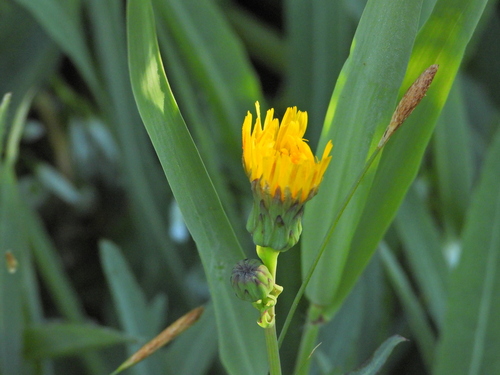
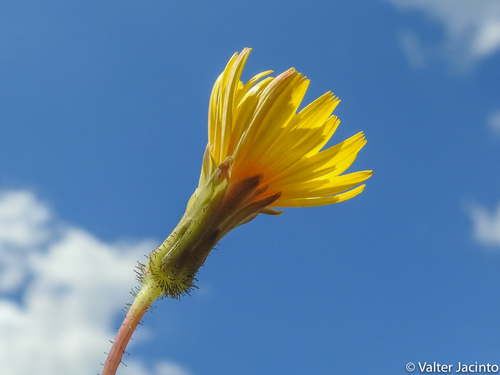
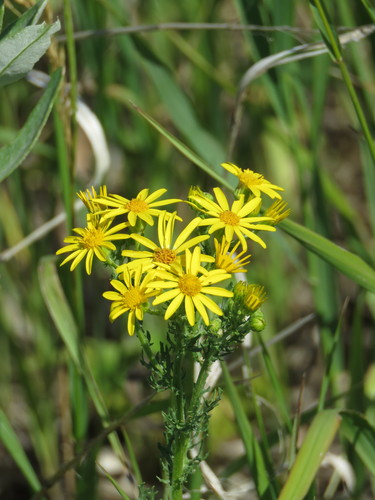
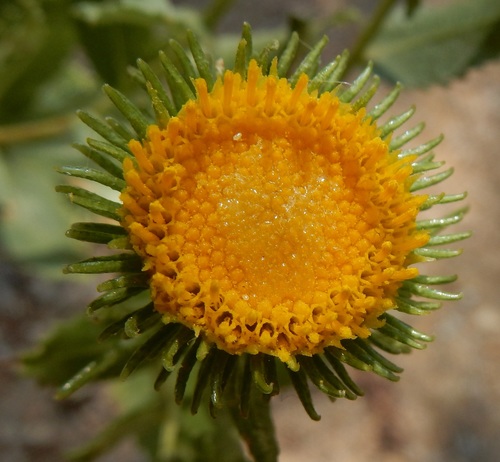
This species, currently named Grindelia nuda Alph.Wood (originally described under the name Grindelia squarrosa), is an erect, branched biennial or perennial herb or subshrub that typically grows 40–100 cm tall. Its leaves are 1.5–7.5 cm (1⁄2–3 in) long, gray-green, and resinous, with crenate margins where each tooth bears a yellow bump near its tip. The plant produces numerous flower heads arranged in open, branching clusters. The involucre (flower bract) is moderately to strongly resinous, made up of multiple overlapping rows of phyllaries; the phyllary tips are strongly curled outward, hooked or looped, and sometimes curl all the way back to form a circle. Each flower head usually holds 12–40 yellow ray flowers, though ray flowers are sometimes absent, surrounding many small disc flowers. It blooms from July through late September. Its brown seeds are usually four-angled, with loose scales. It is native to western and central North America, ranging from British Columbia east to Québec and New England, and south to California, New Mexico, Arizona, Chihuahua, and Texas. Much of the eastern portion of this range may consist of naturalized populations, and the species has been introduced to Ukraine in Asia. It most often grows in dry, open areas, as well as disturbed roadsides and streamsides, at elevations between 700 metres (2,300 feet) and 2,300 metres (7,500 feet). While sage grouse chicks are reported to eat this plant, its content of tannins, volatile oils, resins, bitter alkaloids, and glucosides give it an unpleasant taste to most wildlife. It is listed by the Lady Bird Johnson Wildflower Center Native Plant Information Network as having special value to native bees. Due to its weedy nature, where it often colonizes disturbed areas on its own, it was tested for seeding disturbed roadsides in Wisconsin, and showed good results even under adverse growing conditions. The plant concentrates selenium from soil, and can be toxic if ingested by cattle, humans, and other mammals, but it is rarely eaten because of its unpleasant taste. Because it is not very palatable to livestock, it becomes more abundant in overgrazed areas and can have a negative impact on grazing ranges. It can also act as an indicator of poor range management, as other plant species can usually outcompete it and slow its spread if allowed to grow undisturbed. Great Plains Tribes use its flowers and leaves as a medicinal herb to treat conditions including asthma, bronchitis, and skin rashes. Powdered flowers were historically smoked in cigarettes to ease asthmatic symptoms. It is used as a traditional medicinal plant by Shoshone peoples in various regions. The Gosiute name for the plant is mu’-ha-kûm, and the Lakota name is pteíčhiyuȟa. Hispanos of New Mexico boiled its buds to make a drink for treating kidney disorders. Extracts of the plant have been used to treat skin irritations, asthma, and rheumatism, and its resin has been used topically to treat poison ivy rashes. The plant is currently being explored as a potential source of biofuel, because it contains high amounts of mono- and di-terpenes that can be converted into a fuel similar to kerosene or jet fuel. Its adaptation to arid climates makes it an attractive option for this use, since cultivating it in desert areas would not compete with cultivation of traditional food crops.