About Grimothea planipes (Stimpson, 1860)
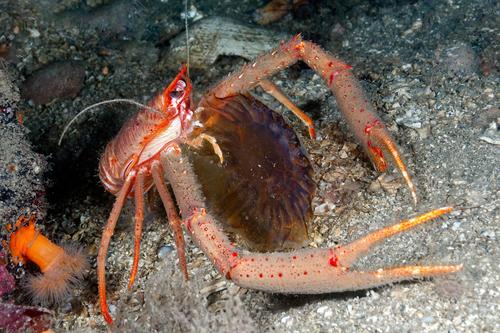
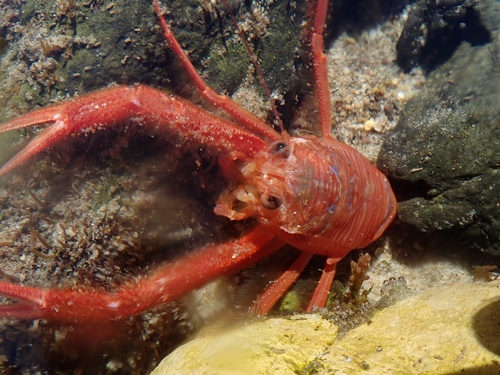
Grimothea planipes (first described by Stimpson in 1860) is a bright red species that reaches up to 13 centimetres (5.1 inches) in length. It resembles a true lobster, but has a shorter abdomen. This species lives on the continental shelf west of Mexico. It is normally found only southwest of San Diego, but its range may extend north into California during warmer years, and this northward expansion is typically a sign of an El Niño event. Adult individuals perform vertical migrations to near the ocean surface, and large numbers will occasionally wash up on beaches during warm water events. The southern edge of this species' range reaches Chile. For a long time, the life cycle of Grimothea planipes presented a paradox: a stable adult population was maintained along the southwestern coast of the United States, but the planktonic larvae that adults released were immediately carried thousands of miles out to sea by the California Current. Researchers proposed a solution to this paradox: larvae use an opposing lower-depth undercurrent to return to the continental shelf. This hypothesis has been confirmed through sampling different water depths with a plankton recorder. Grimothea planipes usually feeds on protists and zooplankton, but it will also filter feed on diatom blooms. As the most abundant micronekton species in the California Current, Grimothea planipes fills an important ecological role: it converts primary production into usable energy for larger organisms. Accordingly, G. planipes is an important food source for many species of birds, marine mammals, and fish. It is a preferred prey of tuna, which gives the species one of its common names: tuna crab. Other fish that are known to feed on G. planipes include billfishes, yellowtail amberjack, sharks, and Epinephelus analogus. Gray whales, Bryde's whales, blue whales, and sea otters all include G. planipes in their diets. The Mexican endemic bat Myotis vivesi also feeds on G. planipes during parts of the year. Off Baja California, some loggerhead sea turtles have been found with stomachs containing only G. planipes. Because G. planipes can wash ashore in large numbers, it becomes a valuable food source for seabirds like the herring gull (Larus argentuatus), which normally experience reduced food availability during El Niño years.