About Grifola frondosa (Dicks.) Gray
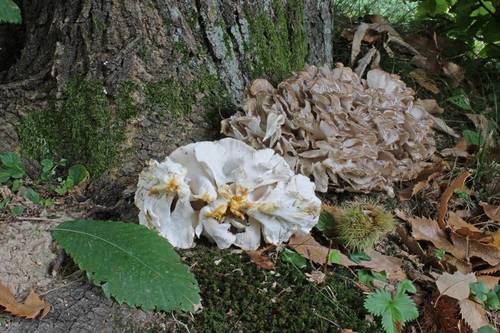
Grifola frondosa grows from an underground, tuber-like structure called a sclerotium, which is roughly the size of a potato. Its fruiting bodies grow in clumps that reach up to 50 cm (20 in) across, and rarely reach 150 cm (60 in). The mushrooms become tougher as they mature. Individual caps are grayish-brown, usually curled or spoon-shaped with wavy margins, and measure 2–10 cm (1–4 in) across. The undersurface of each cap holds 1 to 3 pores per millimeter, and the pore tubes are rarely deeper than 3 mm (1⁄8 in). The cream-colored stipe (stalk) has a branched structure. This fungus produces a white spore print. In Japan, maitake (the common name for this species) can grow to weigh more than 45 kilograms (100 pounds). Grifola frondosa is native to China, Europe, and eastern North America. In Europe, it appears from August to October, while in eastern North America it occurs from September to October. It grows most abundantly in eastern North America, but has been found as far west as Idaho. Like the sulphur shelf mushroom, G. frondosa is a perennial fungus that often grows in the same location for several consecutive years. Grifola frondosa is considered a high-quality edible mushroom. Young caps are especially desirable when slow cooked, though some people may have an allergic reaction to the species. Softer caps require thorough cooking, and the mushroom can also be prepared by pickling. It has been consumed for centuries in China and Japan, where it counts as one of the major culinary mushrooms. It is used in many Japanese dishes, including nabemono.

