About Grevillea lavandulacea Schltdl.
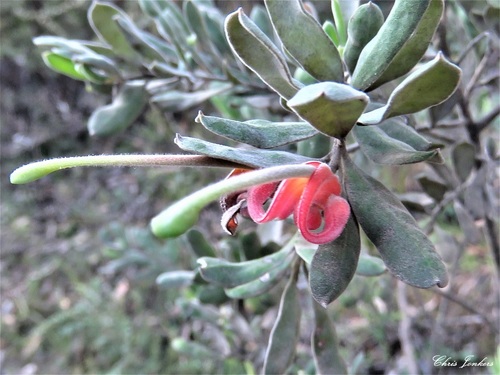
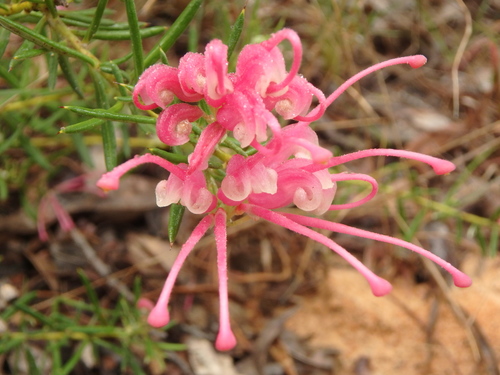
Grevillea lavandulacea Schltdl. is a spreading to prostrate shrub that typically reaches a height of 0.2 to 1.5 metres (7.9 inches to 4 feet 11.1 inches). Its adult leaves are narrow elliptic to linear, 5 to 40 millimetres (0.20 to 1.57 inches) long and 0.5 to 10 millimetres (0.020 to 0.394 inches) wide, with down-turned edges. Flowers are arranged on short side branches in clusters that mostly contain 2 to 10 individual flowers, on a rachis 0.5 to 5 millimetres (0.020 to 0.197 inches) long. The flowers are red or pink, with a silky hairy outer surface, and a pistil 21.5 to 28.5 millimetres (0.85 to 1.12 inches) long. Flowering occurs from late winter to early summer, and the fruit is a narrowly oblong, softly hairy follicle 10 to 15 millimetres long. Two subspecies are recognised with distinct distributions and habitats. Subspecies lavendulacea grows in habitats ranging from heathland to open woodland and dense shrubland, and occurs in south-eastern South Australia (including the Flinders Range) and west of the Grampians in western Victoria. Subspecies rogersii grows in shrubland, forest and woodland, and is restricted to Kangaroo Island in South Australia. This species is cultivated as an ornamental plant for use in well draining, drought-tolerant gardens. A number of naturally occurring forms from different localities including Adelaide Hills, Black Range, Flinders Ranges, Little Desert, Mount Compass, Penola, Victor Harbor and Woakwine have been introduced into cultivation. The commonly grown cultivar G. lavendulacea 'Tanunda' is thought to have originated from Aldinga in South Australia, rather than from Tanunda in the Barossa Valley, where a different form of the species occurs.