About Grevillea laurifolia Sieber ex Meisn.
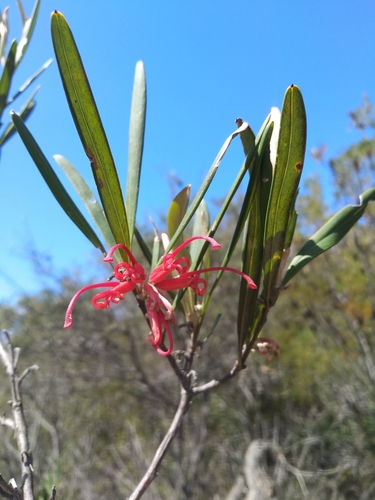
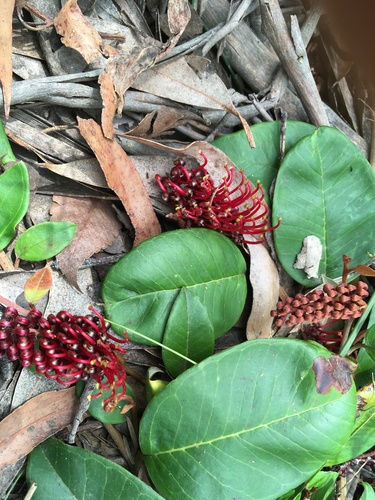
Grevillea laurifolia Sieber ex Meisn. is a prostrate, trailing shrub that can reach 4.5 meters (15 feet) in diameter. Its leaves range from egg-shaped to elliptic, and are sometimes heart-shaped or round, measuring 25–160 mm (0.98–6.30 in) long and 25–60 mm (0.98–2.36 in) wide, borne on a 6–28 mm (0.24–1.10 in) long petiole. Leaf edges are sometimes wavy, and the lower leaf surface is covered in silky hairs. Flowers are arranged along one side of a 20–80 mm (0.79–3.15 in) long rachis, and are reddish to deep maroon in color, with a green to yellow tip on the style, and a pistil 13–25 mm (0.51–0.98 in) long. Flowering occurs mainly from September to January, peaking in November, and the fruit is a woolly-hairy follicle 9.0–9.5 mm (0.35–0.37 in) long. Two subspecies have distinct ranges in eastern Australia. Subspecies laurifolia grows in the Blue Mountains between Valley Heights and Wentworth Falls, at altitudes between 250 and 835 m (820 and 2,740 ft). Subspecies caleyana occurs mostly in the upper Blue Mountains between Wentworth Falls, Lithgow, Mount Werong, Wombeyan Caves, and Mittagong, at altitudes from about 500 to 1,000 m (1,600 to 3,300 ft) above sea level. This species grows in low-nutrient soils derived from clay, shale, or sand, on ridges, slopes, or near swampy areas. Its typical habitat is open sclerophyll forest under eucalypts including silvertop ash (Eucalyptus sieberi), Sydney peppermint (Eucalyptus piperita), broad-leaved peppermint (Eucalyptus dives), brittle gum (Eucalyptus mannifera), red stringybark (Eucalyptus macrorhyncha), and brown barrel (Eucalyptus fastigata). It grows alongside shrubs including Mirbelia platyloboides, dense phyllota (Phyllota squarrosa), mountain geebung (Persoonia chamaepitys), myrtle geebung (Persoonia myrtilloides), and stiff-leaf wattle (Acacia obtusifolia). It may also grow in more open woodland or heath associated with Faulconbridge mallee ash (Eucalyptus burgessiana), Blue Mountains mallee ash (Eucalyptus stricta), scribbly gum (Eucalyptus sclerophylla), and silver banksia (Banksia marginata). In horticulture, Grevillea laurifolia adapts easily to cultivation when given good drainage and a sunny position, but often struggles to grow at lower altitudes. Larger-leaved forms have been selected for horticulture, where they make attractive groundcover plants that can attract birds to gardens. The vigorous cultivar Grevillea 'Poorinda Royal Mantle' was bred by Victorian plantsman Leo Hodge and registered in 1978, and is thought to be a hybrid between G. laurifolia and G. willisii. Subspecies caleyana is the most commonly cultivated subspecies, due to its larger flowers.