About Grevillea caleyi R.Br.
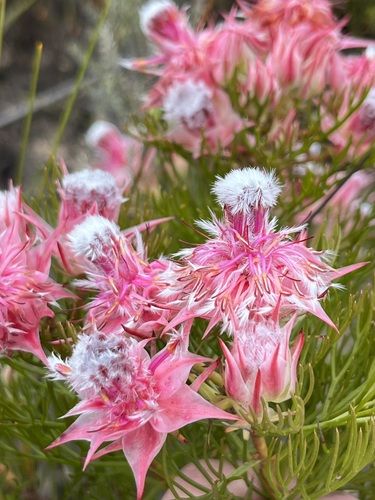
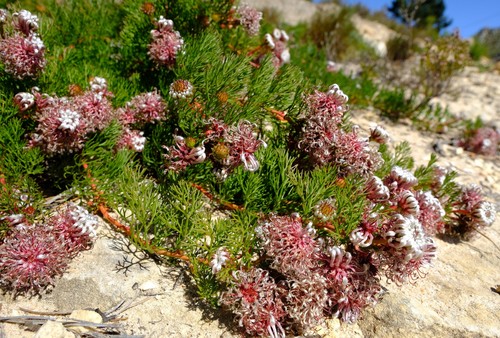
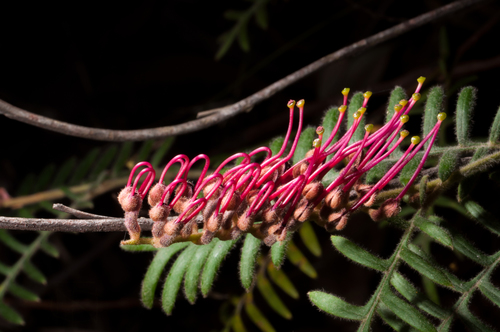
Grevillea caleyi, commonly known as Caley's grevillea, is an open, spreading shrub that typically grows 1–4 m (3 ft 3 in – 13 ft 1 in) tall and up to 4 m (13 ft) wide. It has characteristic, deeply divided "herringbone" leaves that are comparatively large, measuring 70–180 mm (2.8–7.1 in) long and 30–75 mm (1.2–3.0 in) wide, with 19 to 36 linear to lance-shaped lobes that narrow toward the base. The lobes are 15–35 mm (0.59–1.38 in) long and 2–6 mm (0.079–0.236 in) wide, with downward-turned edges and hairs on the lower leaf surface. Flowers are arranged in toothbrush-like clusters on a 40–80 mm (1.6–3.1 in) long rachis. The perianth is fawn-colored and covered in long soft hairs on its outer surface. The pistil is 25–28 mm (0.98–1.10 in) long, with a maroon-red glabrous style and a green pollen presenter at the tip. Flowering occurs sporadically throughout the year, with peak flowering from August to December. The fruit is a woolly hairy follicle 17–21 mm (0.67–0.83 in) long marked with reddish brown stripes or blotches. Each follicle contains a single woody, ellipsoidal seed that measures 15–20 mm (0.59–0.79 in) long and 4–5 mm (0.16–0.20 in) wide. This is a distinctive, easily recognisable species most closely related to Grevillea aspleniifolia.
Caley's grevillea has a restricted distribution limited to a 64 km² (25 sq mi) area covering the Sydney suburbs of Terrey Hills, Belrose and Ingleside, within the endangered Duffys Forest ecological community. It grows in open woodland and open forest on ridgetops, at elevations between 170 and 240 metres (560 to 790 ft) above sea level, on iron-rich laterite sandstone soils. Common plant species associated with G. caleyi include the trees Corymbia gummifera, Eucalyptus sieberi, Eucalyptus haemastoma, Banksia serrata and Xylomelum pyriforme; the shrubs Acacia myrtifolia, Banksia spinulosa, Conospermum longifolium, Grevillea buxifolia, Hakea dactyloides, Lambertia formosa, Pimelea linifolia and Telopea speciosissima; and herbaceous plants including Anisopogon avenaceus, Dampiera stricta, Lomandra glauca, Lomandra obliqua and Pteridium esculentum.
In ecological terms, G. caleyi is killed by fire. It does not form a lignotuber or propagate by suckering, so it relies entirely on soil-stored seed for regeneration. While seedlings can grow without bushfires, they sprout in large numbers after recent bushfires, which suggests seeds remain dormant in soil until stimulated to grow, most likely by intense heat, smoke, or exposure to bright sunlight. Due to low fecundity (only approximately 3% of flowers produce seed), low seed dispersal, and high seed predation, it is estimated to take 8–12 years for a sufficient seedbank to develop to replace an entire population. Seedlings generally do not produce flowers or seeds until they are 2–5 years old. This species is pollinated by birds; casual observations indicate common likely pollinators include honeyeaters such as New Holland honeyeaters, white-eared honeyeaters and white-cheeked honeyeaters, as well as silvereyes, little wattlebirds and eastern spinebills. It is also thought that this species may be self-compatible.
Caley's grevillea is occasionally grown as an ornamental plant, and has been cultivated in gardens across Australia. Like most grevilleas, it grows best in well-drained, acidic, gravelly or sandy loam soil in a sunny position to support optimal flowering, though it will also grow in partial shade. It tolerates frosts to at least −6 °C (21 °F) and can withstand extended dry periods, but cannot survive severe drought. It is usually propagated from seed, and will self-sow in gardens, but it can also be readily propagated from cuttings or grafted onto rootstock — most commonly Grevillea robusta rootstock, which allows it to grow in a wider range of soil types. Grafted G. caleyi plants tend to be hardier and live longer than plants grown from seed. It hybridises easily with other related grevillea species, including G. aspleniifolia and G. longifolia. This ease of hybridisation has resulted in a large number of hybrids and cultivars becoming available to gardeners, including several 'Poorinda' varieties such as 'Poorinda Empress' and 'Poorinda Emblem'. The popular cultivar Grevillea 'Ivanhoe' is recorded as a hybrid between G. caleyi and G. longifolia.