About Grevillea australis R.Br.
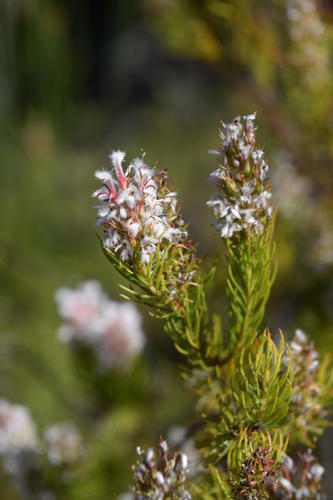
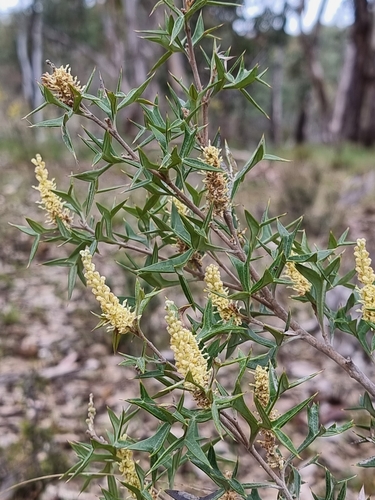
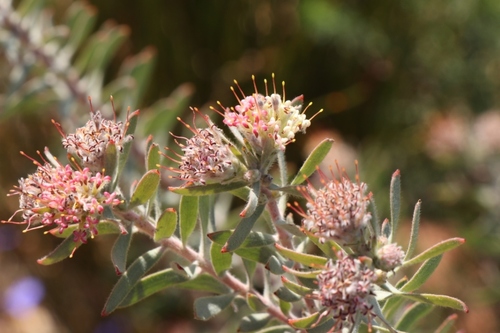
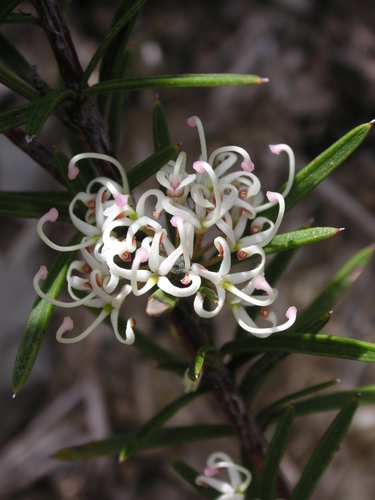
Grevillea australis R.Br. is a densely-foliaged shrub, with growth forms ranging from erect to spreading, and sometimes prostrate. It reaches a height between 0.3 and 1.2 metres (1 foot 0 inches to 3 feet 11 inches). Its leaves are simple, shaped as narrowly egg-shaped with the narrower end towards the base, or linear. Leaves measure 5 to 30 millimetres (0.20 to 1.18 inches) long and 0.5 to 5.5 millimetres (0.020 to 0.217 inches) wide, with edges turned down or rolled under. Flowers are arranged in groups near the ends of branches, along a rachis that is 1.0 to 2.5 millimetres (0.039 to 0.098 inches) long, and flowers are white or pale pink. The pistil is 6.0 to 7.5 millimetres (0.24 to 0.30 inches) long and cream-coloured; the style is hooked near the tip, and the ovary is stalked and glabrous. Flowering occurs mostly from December to February, and the fruit is a glabrous follicle. This species, commonly called alpine grevillea, grows in heath and woodland, usually in moist, rocky locations in mountain and alpine areas. Its range extends south from the Brindabella Range in the Australian Capital Territory, through southern New South Wales, to Mount Buller and Mount Baw Baw in Victoria. It is also common in Tasmania, especially on the Central Plateau, and is the only grevillea species native to that state. For horticultural use, Grevillea australis grows best in cool to cold climates, and performs best in sunny locations with well-drained soil.