About Grevillea aquifolium Lindl.
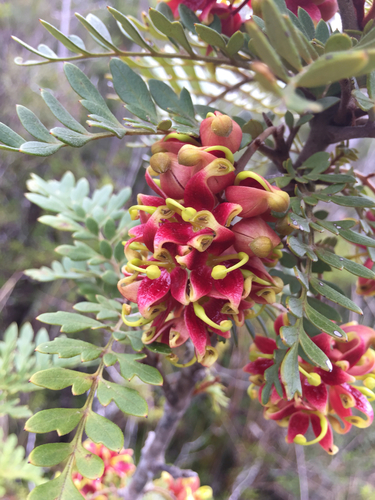
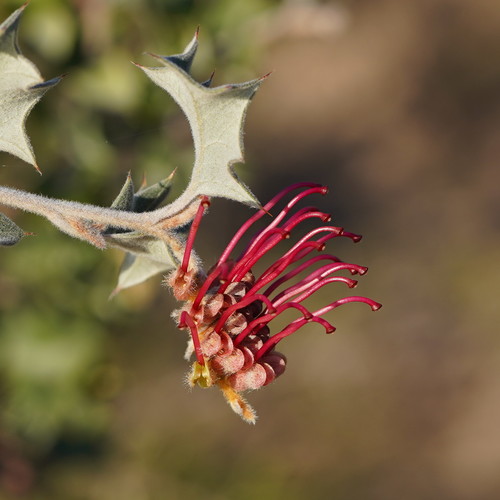
Grevillea aquifolium Lindl. shows high plasticity in leaf shape, growth form, and habitat preferences across its natural range. Shrubby forms usually grow between 1 and 2 metres (3 ft 3 in and 6 ft 7 in) tall, and can reach up to 4 metres (13 ft) in some populations. Prostrate forms are also found within the species' natural distribution, sometimes growing alongside shrubby forms. Its flowers are arranged in terminal, one-sided racemes, which is the characteristic growth form of the group commonly called "toothbrush" grevilleas. Flower colour is most often red, and occasionally yellowish-green. Flowering occurs between November and March in South Australia, and extends from September to April in the Grampians, Victoria. The foliage is typically lobed, with sharp points on the lobe tips, though some populations have leaves with nearly entire margins. Grevillea aquifolium is native to the south-east of South Australia and western Victoria. In South Australia, small populations are located at sites including Carpenter Rocks, Bucks Lake Game Reserve, and West Dairy Range. In Victoria, the species occurs in the Grampians region, extending north to the Little Desert, and also grows near the south coast at Kentbruck Heath close to Portland. In Victoria, common associated tree species include Eucalyptus baxteri, Eucalyptus obliqua, Eucalyptus willisii subsp. falciformis, and Callitris rhomboidea. Putative hybrids between G. aquifolium and Grevillea microstegia occur near Mount Cassel, and hybrids between G. aquifolium and Grevillea montis-cole occur near Mount William. Birds are thought to be the main pollinators of this species, and bees and ants may also contribute to pollination. Multiple naturally occurring forms of the species have been brought into cultivation, sourced from locations including Carpenter Rocks, Cooack, Halls Gap, Kenbruck Heath, Lake Wartook, Little Desert, Mount William, and Serra Road. 'Copper Crest', a hybrid between G. aquifolium and G. acanthifolia, is a commercially available cultivar selected in Montrose, Victoria in 1975. In horticulture, Grevillea aquifolium grows best in a well-drained position with full sun or partial shade. Mature plants are drought tolerant and have moderate frost tolerance, but do not tolerate high humidity. Plants can be propagated from cuttings taken from semi-mature growth.