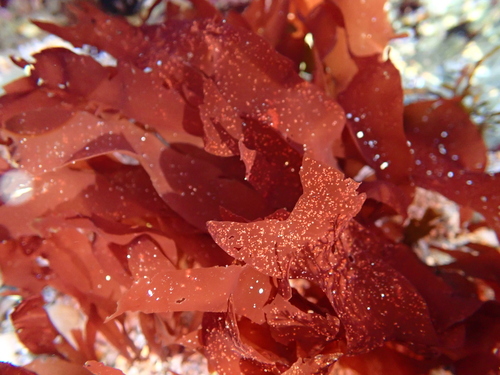
About Grateloupia turuturu Yamada
Grateloupia turuturu Yamada is a large seaweed species with coloration ranging across multiple shades of red, maroon, and burgundy. Dying or dead individuals may turn yellow instead. Its texture is soft and gelatinous. The blades of this seaweed vary in size and shape, and typically 1 to 8 blades grow from a central point, attached by a cylindrical holdfast. Each blade can grow up to almost one meter long, measuring 3 to 15 centimeters wide, and ranging 10 to 70 centimeters in length. Currently, G. turuturu is found across Asia, Europe, North America, and Oceania. It is native to China, Japan, and South Korea. In Europe, it occurs in France, Italy, the Netherlands, Portugal, Russia, Spain, the United Kingdom, and the Channel Islands. In North America, it can be found in Mexico and the United States, specifically in the states of Connecticut, Massachusetts, New York, and Rhode Island. In Oceania, it is present in Australia and New Zealand. Grateloupia turuturu is a perennial species with an average lifespan of 6 to 10 years. It grows best in nutrient-rich eutrophic waters, and is most commonly found on rocky substrates near shallow coastal shores. This species can grow quickly, reaching peak biomass in late summer and early autumn, while growth begins to slow in late spring and early summer. It has adapted to survive in a wide range of temperatures and salinity levels from 12 to 52 ppt, and can maintain normal growth at temperatures as low as 3°C and as high as 29°C. This tolerance allows it to withstand many environmental changes, making it an increasingly threatening invasive species. Several small invertebrates, including shrimp, snails, juvenile fish, and crabs, live near G. turuturu populations. There is little evidence of herbivory feeding on this seaweed. Grateloupia turuturu can reproduce both sexually and asexually; asexual reproduction occurs via spores and through vegetative propagation. Peak reproduction takes place in summer, when an average of 90% of individuals are fertile. Germination of this species follows a pattern similar to many other natural seaweeds: large dense masses of non-motile aplanospores are released into the environment. Since these red algal spores cannot swim, they depend on water currents for dispersal. When spores settle, they form small rounded discs that develop through a germ tube. These discs can produce multiple shoots, each capable of releasing thousands of additional spores. Vegetative reproduction happens when a fragment of the original plant breaks off and develops directly into a new individual. All offspring produced through this asexual method are genetically identical to one another. Grateloupia turuturu is edible.

