About Graptemys nigrinoda Cagle, 1954
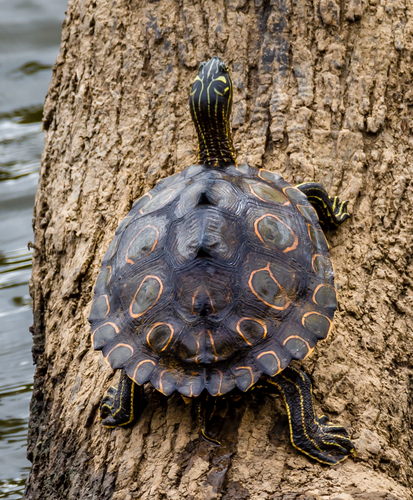
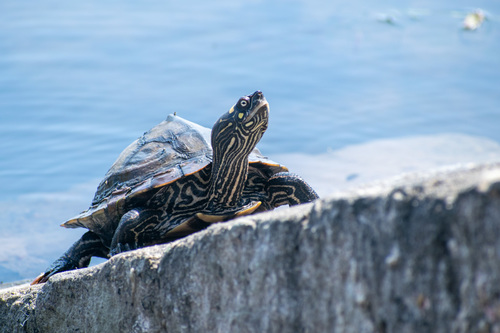
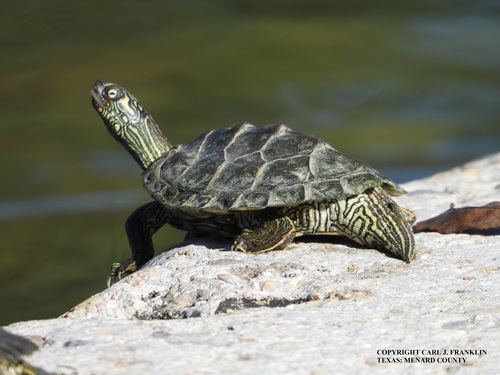
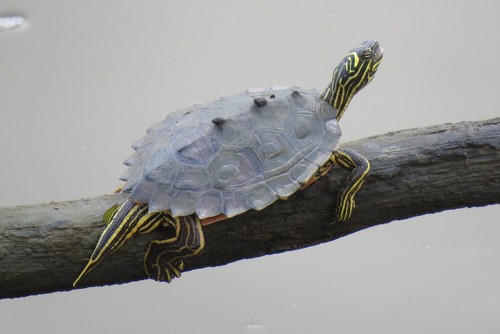
Graptemys nigrinoda, commonly called the black-knobbed map turtle, has a slightly domed carapace. The first four vertebral sections of this carapace bear black, backward-projecting knob-like processes, with the second and third processes larger than the first and fourth. In older females, these knobs shrink down to small swellings. The overall color of the carapace is dark olive-brown. Each pleural plate of the shell contains yellow-green circular rings outlined in black. Hatchlings share the same base color pattern as adults, but their colors are more vibrant and contrasting, and their knob-like processes are compressed laterally. This species has a small dark brown head marked with yellow stripes, including yellow crescents that point toward the posterior end of the turtle behind each eye. These yellow stripes continue onto the legs, and the underside of each leg is lighter than its dorsal surface. Clear sexual dimorphism exists in Graptemys nigrinoda: adult females are approximately twice the size of males, have higher carapaces than males, while males have longer tails than females. Recorded carapace length ranges from 7.6 to 10.2 cm (3.0 to 4.0 in) for males, and 10.2 to 19.1 cm (4.0 to 7.5 in) for females. The black-knobbed map turtle is endemic to the southeastern United States. It occurs in the Mobile Bay drainage in Alabama, and in the Tombigbee River system in Mississippi, as well as in the Black Warrior River north to Jefferson County, Alabama. It can only survive in fresh water, so it is restricted to freshwater river systems. Black-knobbed map turtles are active seasonally from April to late November. They routinely bask in early morning and early afternoon each day. Basking is thought to serve the purposes of thermoregulation, plus removing parasites and algal growth. When approached, these turtles jump into nearby water, then seek shelter between the branches of fallen trees on the river bottom. Most inhabited riverbeds have sand and clay bottoms and moderate currents. Hatchlings prefer slower, more sluggish waters off the main river channel. Little is known about this species' overall foraging behavior. It has been observed eating beetles and dragonflies that have fallen into the river. A study of stomach contents by Lahanas found a difference in the percentage of food types between sexes: males had approximately 58% animal matter and 40% plant matter, while females had 70% animal matter and 29% plant matter. The top three sources of animal matter for this species are freshwater sponges, bryozoans, and molluscs, and the only plant matter found was a type of freshwater alga. This species feeds primarily on insects. Males reach sexual maturity at 3 to 4 years old, while females reach sexual maturity at 7 to 8 years old. Females produce clutches of roughly five eggs, and can lay three or four clutches in a single year. Nesting takes place from May to August, occurs at night on sandbanks.