About Graptemys geographica (Lesueur, 1817)
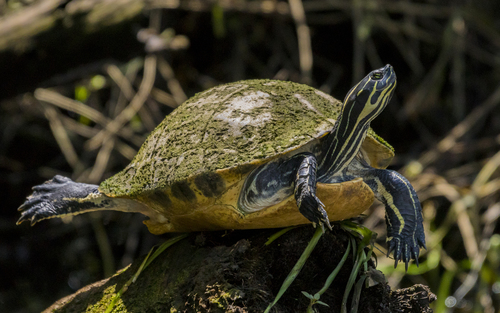
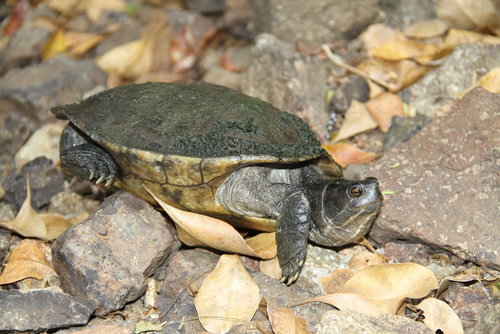
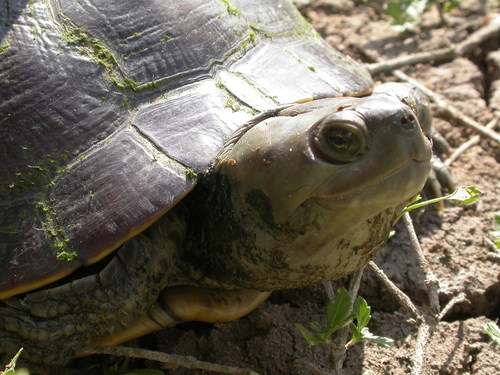
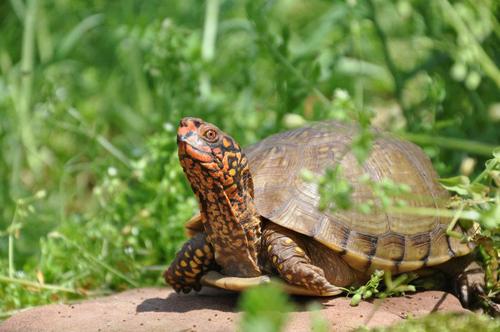
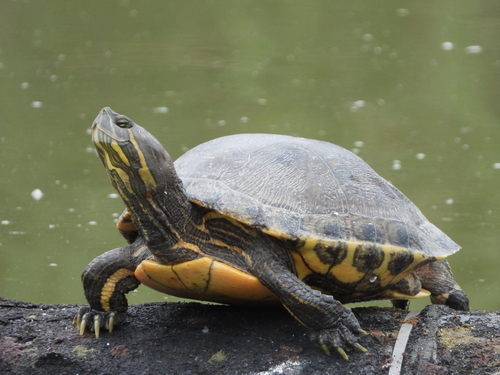
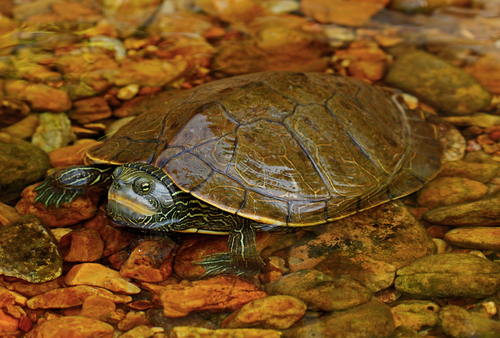
Both the common and scientific name of the northern map turtle, Graptemys geographica, come from the markings on its carapace, which resemble contour lines on a map or chart. These markings are typically yellow, tan, or orange, enclosed by dark borders, and the rest of the carapace is olive or greyish brown. The carapace markings fade as the turtle matures; in older individuals, markings are usually only visible when the shell is wet. The carapace is broad, has a hydrodynamic shape, and features a moderately low keel. The rear of the carapace is flared, and the rear marginal scutes form serrations. The plastron is yellowish, with a central dark blotch that follows the sutures between plastral scutes. This dark marking also fades with age, and many adults have no pattern at all, with an entirely immaculate plastron. The head, neck, limbs, and tail are dark green with thin yellow stripes, and there is an oval or triangular spot behind each eye. Like other map turtles, this species shows extreme sexual size dimorphism. Males have a carapace length of 10–16 cm (3.9–6.3 in) and weigh 150–400 g (5.3–14.1 oz), while females reach 18–27 cm (7.1–10.6 in) in carapace length and weigh 0.67–2.5 kg (1.5–5.5 lb). Females also have much wider heads than males, a trait linked to differences in feeding. Males have a narrower carapace with a more distinct keel, a narrower head, and a longer, thicker tail. Unlike females, the male cloacal opening sits beyond the rear edge of the carapace. Young northern map turtles have a pronounced dorsal keel. Hatchlings have a round, greyish-brown carapace that measures approximately 2.5 cm (0.98 in) long. The species’ native range stretches from southern Quebec and Ontario to northern Vermont, covering the St. Lawrence River drainage basin. The range extends west through the Great Lakes into southern Wisconsin and eastern Minnesota, west of the Appalachians, and south to Kansas and northwestern Georgia. A population has been recorded in northeastern Mississippi. Northern map turtles also live in the Susquehanna River system of Pennsylvania and Maryland, and in the Delaware River. A small introduced population exists in the Czech Republic, formed from escaped or released pet turtles and their descendants. In the Czech Republic, this species is considered alien, and it faces the same threats to survival as native Czech turtles, other reptiles, and amphibians from the large invasive population of red-eared sliders (Trachemys scripta elegans). Northern map turtles live in ponds, rivers, and lakes, preferring large bodies of water with fallen trees and other debris that provide basking sites. They are found more often in rivers than in lakes or ponds. In the northern part of their range, they occupy larger rivers and lakes, while in the southern and western parts, they are more commonly found in smaller rocky rivers and streams. Like all turtles, they require sunlight to survive. Northern map turtles are dormant from November through April, with timing dependent on local climate conditions. They spend the winter underwater and do not surface to breathe, especially when ice cover makes surfacing impossible. Adults rest on the water bottom or wedge themselves under rocks or logs, and often hibernate in groups with other northern map turtles, remaining somewhat active throughout the winter. Hibernation sites need to be well oxygenated, because unlike some other turtle species such as painted turtles, map turtles must absorb oxygen from the water to survive the winter. They typically bask in groups and are diurnal, active only during daylight hours. Northern map turtles are quite shy and difficult to approach; they usually slip into the water and hide at the first sign of danger. Northern map turtles breed in spring and fall, with most mating occurring in deep water. The nesting season runs from May to July. Females strongly prefer unshaded, sandy soil sites, and typically select well-drained areas to deposit their eggs. Females dig the nest cavity with their hind feet. Clutch size ranges from six to 20 eggs. The eggs are oval, around 3.2 cm (1.3 in) long, and have flexible shells. After laying, the female fills in the nest cavity. Incubation takes 50 to 70 days, and most hatchlings emerge between August and September. If a nest hatches late, northern map turtle hatchlings are known to overwinter inside the nest. A female usually lays two or more clutches in a single breeding season. Offspring sex is determined by incubation temperature: incubation at 25 °C (77 °F) produces mostly males, while incubation at 30 to 35 °C (86 to 95 °F) produces mostly females.