About Grapsus grapsus (Linnaeus, 1758)
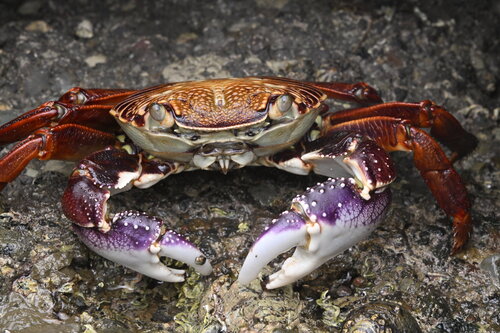
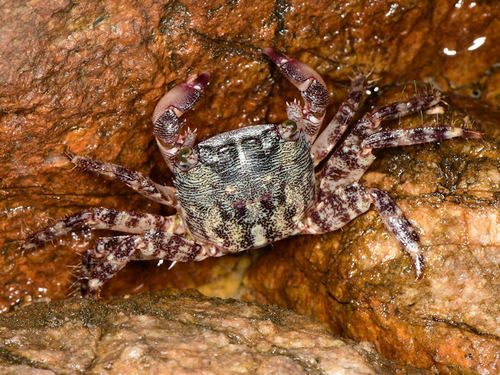
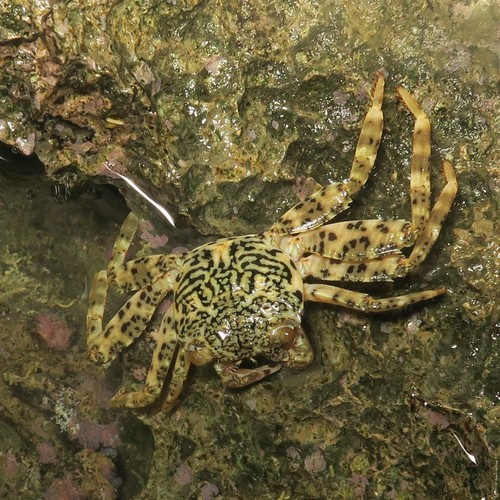
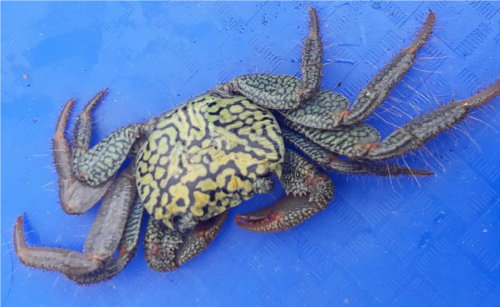
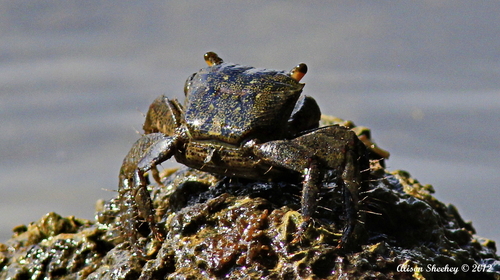
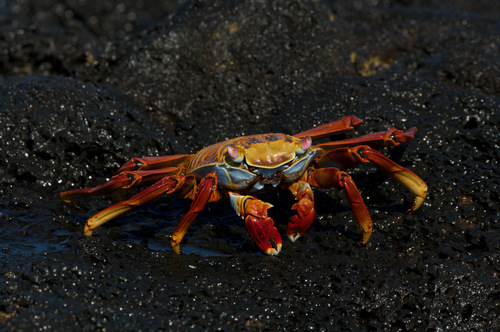
Grapsus grapsus (Linnaeus, 1758) is a crab with the typical body shape of its group. It has five pairs of legs; the front two pairs hold small, blocky, symmetrical chelae (claws). The remaining legs are broad and flat, and only their tips touch the surface the crab walks on. The crab's round, flat carapace is slightly longer than 8 centimeters (3.1 in). Young Grapsus grapsus are black or dark brown, which provides good camouflage against the black lava coasts of volcanic islands. Adult coloration varies widely: some individuals are muted brownish-red, while others are mottled, spotted brown, pink, or yellow. Grapsus grapsus occurs along the Pacific coast of Mexico, Central America, and South America, ranging south as far as northern Peru, as well as on nearby islands including the Galápagos Islands. It is also found along the Atlantic coast of South America, but is replaced by its congener Grapsus adscensionis in the eastern Atlantic Ocean, around Ascension Island and West Africa. This species lives among rocks on the often turbulent, windy shore, positioned just above the maximum reach of sea spray. It feeds primarily on algae, and will occasionally consume other plant matter, sponges, mollusks (such as clams), crustaceans (including other crabs), fish, young sea turtles, bird eggs, bird droppings, bat guano, and dead animals (mainly seals and birds). Larval Grapsus grapsus feed on phytoplankton. They have been recorded engaging in cannibalism when population density is high or food is scarce. Grapsus grapsus is an agile crab capable of leaping, which makes it hard to catch. Humans do not consider it very edible, but fishermen use it as bait. Its predators include the chain moray eel Echidna catenata and octopuses. In the Galápagos Islands, Grapsus grapsus has been observed engaging in an apparent cleaning symbiosis, where it removes ticks from marine iguanas. Grapsus grapsus was collected by Charles Darwin during his voyage aboard HMS Beagle, and was also collected during the first comprehensive study of the Gulf of California fauna, carried out by Ed Ricketts alongside John Steinbeck and others. John Steinbeck wrote of the species: "These little crabs, with brilliant cloisonné carapaces, walk on their tiptoes, They have remarkable eyes and an extremely fast reaction time. In spite of the fact that they swarm on the rocks at the Cape [San Lucas], and to a less degree inside the Gulf [of California], they are exceedingly hard to catch. They seem to be able to run in any of four directions; but more than this, perhaps because of their rapid reaction time, they appear to read the mind of their hunter."