About Grapsus albolineatus Latreille, 1812
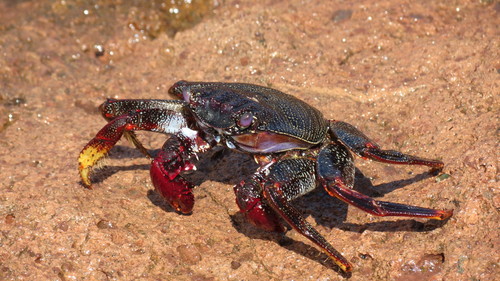
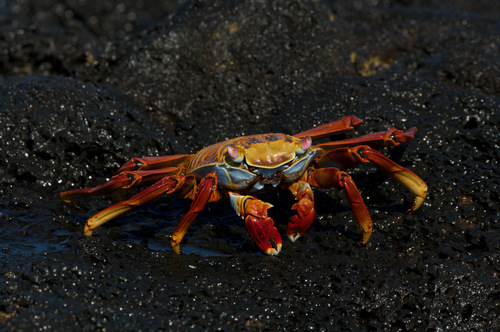
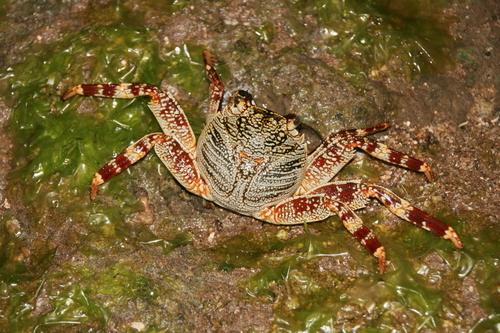
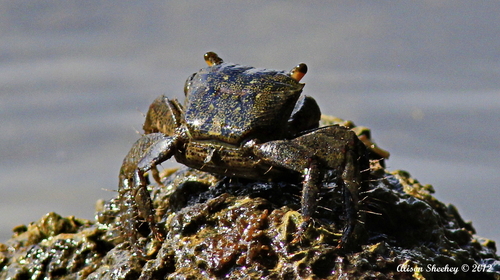
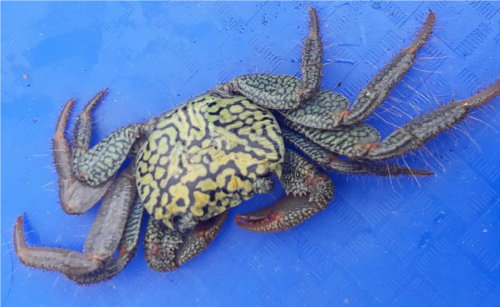
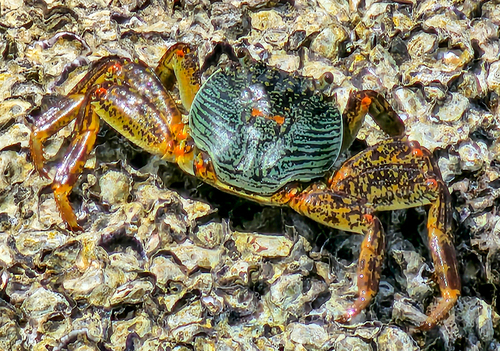
Description: The carapace (upper shell) of Grapsus albolineatus is flat, roughly circular, and textured, with arched lateral margins. It can reach up to 37 millimeters in length. The chelae (claws) are short, small, and flattened, while the pereiopods (walking legs) are long with tapered ends. The inferior margin of the last pair of legs has a serrated texture. Male individuals of this species have larger claws than female individuals. This species can be red, blue, or green in overall body color. Its legs match this base body color, and have irregular dark brown mottled markings. Habitat and distribution: This species inhabits rocky depths and coral reefs. It is distributed across the Indo-Pacific region, ranging from the East African coast to the Chilean coast. Its known range includes the waters of the Red Sea, the Gulf of Aqaba, India, Indonesia, Pakistan, Japan, Australia, and tropical Pacific islands such as Hawaii. Reproduction: As with most other true crabs, light and temperature are the main environmental factors that determine this species' reproductive activity. Females carry their fertilized eggs on their abdomen. This species has a long planktonic larval phase. As larvae mature, they go through a series of molts that enable growth and eventual attainment of sexual maturity.