About Graphium xenocles (Doubleday, 1842)
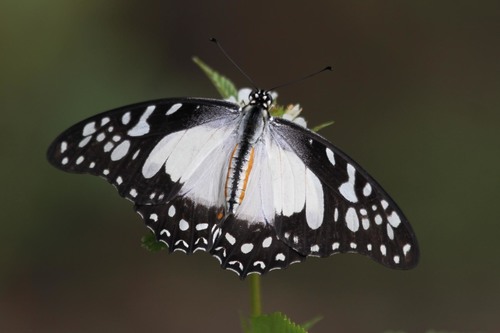
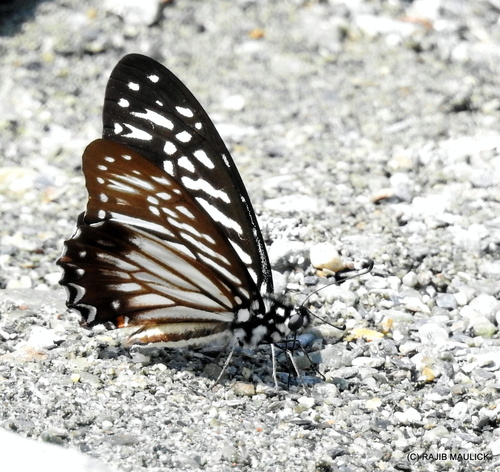
This species is Graphium xenocles (Doubleday, 1842). For males, the upperside is black, and the forewing has the following greenish or bluish-white streaks and spots: the cell contains three transverse, very oblique, broad streaks and two elongate spots near the apex; in the originally described type specimen, the outer two of the three streaks are coalesced; there are broad streaks from the base in interspaces 1a to 3; a series of four rounded spots beyond the apex of the cell in interspaces 4, 5, 6 and 8, followed by five short outwardly truncate or emarginate streaks in interspaces 4 to 8; finally, a complete subterminal series of comparatively large rounded spots. The hindwing has similar greenish-white or bluish-white streaks and spots, arranged as follows: a broad curved streak in the cell; broad streaks from the base in interspaces 1 to 7, these streaks vary in length but always leave a comparatively broad margin of the base black ground colour beyond; the streak in interspace 7 is white, the streak in interspace 1, and in some specimens also in interspace 2, has a large yellow spot beyond its apex; finally, a subterminal series of spots, where some or all of the spots may be absent, but when present the posterior three are always somewhat lunular. The underside is fuliginous brown, and paler towards the apical area of the forewing; markings match those on the upperside, but are duller and less clearly defined. Antennae, head, thorax and abdomen are black; there are two white spots on the head, and white lateral markings on the thorax and abdomen; on the underside, the thorax and abdomen are white, and the abdomen has a narrow medial and a narrow lateral white stripe. Females are similar to males and have the same markings; the markings on the female hindwing often vary more in width than they do in males; the base ground colour of the female hindwing is also generally chestnut red, rather than black or fuliginous. Karl Jordan, in Seitz (page 105), published a description that differentiates G. xenocles from related nearby taxa and discusses some of its forms.