About Graphium nomius (Esper, 1798)
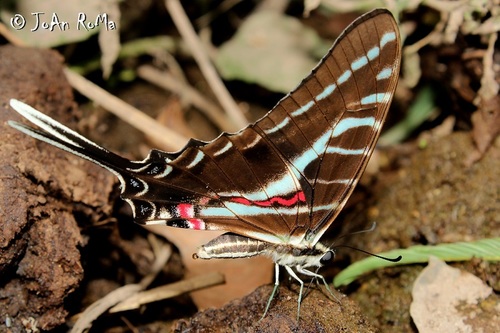
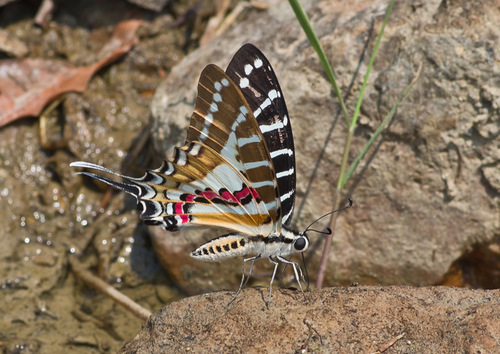
Graphium nomius (Esper, 1798) differs from Graphium antiphates primarily in the greater width of its black upperside markings. This difference is especially noticeable on the basal and subbasal bands that cross the forewing, both of which also extend all the way to the dorsum. On the hindwing, the black markings from the underside basal and discal areas are not only visible by transparency from below, but are also partially represented by actual black scaling on the upperside. The dark grey terminal portion of the hindwing is also wider, and tends to become dusky black toward the anterior edge. This darkening obscures the anterior subterminal series of black lunules, making them difficult to distinguish. The underside of the wings has markings similar to those of Graphium antiphates, but they are broader. On the forewing, the discal transverse band extends from the costa to vein 1. On the hindwing, the black bands that cross the cell are broader and proportionately closer together. The wing expanse of this species is reported as both 94–100 mm and 68–95 mm. For both males and females, the upperside is bluish-white. On the forewing, the cell contains five broad transverse black bands: the basal and subbasal bands extend to the dorsum, the medial band generally extends into interspace 2, the preapical band ends on the median vein, and the fifth apical band runs from the costa along the discocellulars, extends on both sides of these structures, and terminates at the lower apex of the cell. Beyond the fifth band is a short macular transverse bar of the ground colour that terminates on vein 5, followed by a very broad black terminal band that occupies about one-third of the wing's width. This terminal band is crossed by a transverse subterminal series of rounded spots matching the ground colour. On the hindwing, the ground colour is whitish along the dorsum and above vein 7. A streak along the dorsum, a subbasal transverse band, an inner discal transverse band from the costa across the cell, and a very broad terminal band are all black. The subbasal and inner discal bands are joined near the tornus by cross lunular black marks. The terminal band is crossed by a series of slender lunules matching the ground colour. There is a small black spot in interspace 1 above the tornus, and another at the base of interspace 4. The black at the apices of interspaces 2 to 4 and the ground-coloured lunules in these areas are suffused with grey. The tail is black, edged and tipped with white. The underside is white, and black markings are very similar to the upperside but take on a bronze brown colour, with the following exceptions. On the forewing, the extensions of the basal, subbasal, and median transverse bands below the median vein, as well as the inner portion of the broad terminal band below vein 4, are black. On the hindwing, the inner discal band is broken, irregular, and black, and is bordered outwardly by a series of red spots edged with black. The subterminal series of ground-coloured lunules are broadly edged with black on their outer side. The grey patch in the caudal region is replaced by ochraceous grey. Antennae are black; the head, thorax, and abdomen are creamy white, with a broad medial longitudinal stripe. On the underside, the abdomen has lateral black stripes. This species is found in southern and eastern India (including Sikkim and Assam), Sri Lanka, Nepal, Bangladesh, Myanmar, Thailand, Vietnam, Laos, and Cambodia. It generally inhabits deciduous forest areas, among bushes with limited secondary growth. It is locally abundant below 910 m (3,000 feet), and less common at elevations above this level. It typically stays close to hilly, forested terrain. Adult Graphium nomius are active from February to June, and are most abundant between March and April. In western India, they have been recorded from July onward for a few months. In the Nilgiris, they have been recorded from February to October. The larval host plants are Miliusa tomentosum, Miliusa velutina, and Polyalthia longifolia, all members of the plant family Annonaceae. Miliusa tomentosum is a deciduous tree. Pupae from the previous year's brood emerge, seek mates, and lay eggs just as this tree produces new growth.