About Graphium eurous (Leech, 1893)
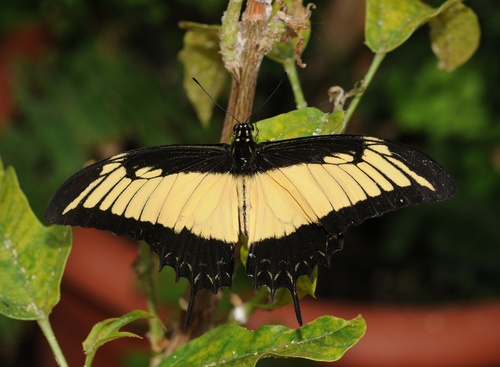
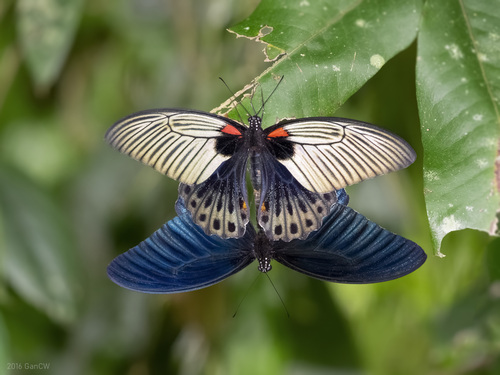
All bands are narrowed, appearing only as blackish stripes on a pale yellow transparent background. Only the anal area of the hindwing is more strongly coloured, bearing a honey-yellow anal spot that is somewhat constricted in the middle. Behind this spot sits a blue-centred dot, which forms the anal ocellus. Karl Jordan in Seitz (page 86) provides a description that differentiates G. eurous from related nearby taxa, and discusses some of its forms. This species is found along the Himalayas, ranging west from northern Pakistan into India (including Jammu & Kashmir, Himachal Pradesh, Garhwal and Kumaon, Sikkim, Assam, Manipur), and also occurs in Nepal, northern Myanmar, south-western and central China, and Taiwan. In the Himalayas, these butterflies inhabit open areas in wooded country between 910 and 2,440 m (3,000 and 8,000 feet). They occupy specific small localities and can always be found within these areas. This species is single-brooded. In the Himachal Pradesh region, adults regularly emerge in mid-April and remain active on the wing until mid-May. Broods emerge slightly further east from Himachal Pradesh, with adults appearing as early as January in Assam. Females usually emerge much later than males; it is not uncommon to see freshly emerged females with perfectly intact wings being courted by males with tattered wings. The larval food plants of the sixbar swordtail (Graphium eurous) are primarily from the family Lauraceae. Haribal lists Persea odoratissima and Michelia doltsopa (from the family Magnoliaceae) as larval host plants. Smetacek (2012) successfully reared larvae to adulthood, confirming the larvae feed on Persea duthei King ex J.D. Hooker and Neolitsea umbrosa (Nees) Gamble.