About Graphium bathycles (Zincken, 1831)
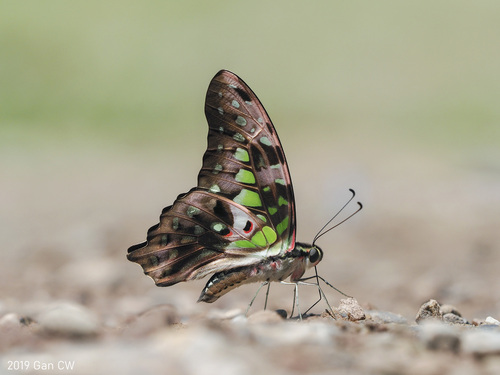
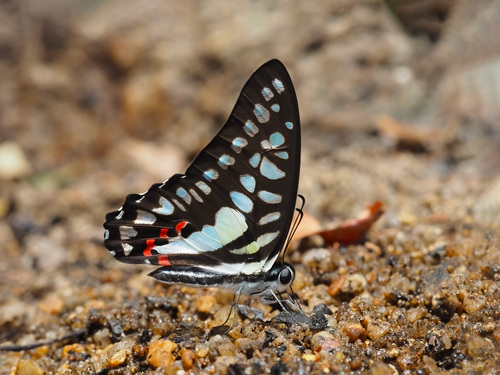
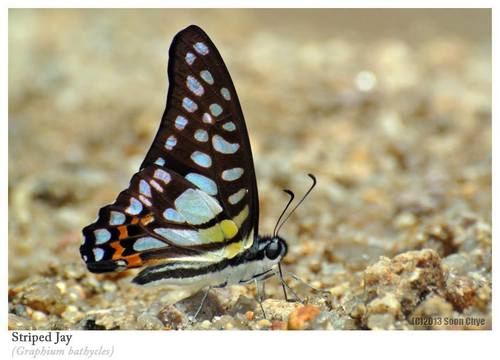
Graphium bathycles, commonly known as the veined jay, is a butterfly species belonging to the family Papilionidae. It is native to the Indomalayan realm. In Seitz's work (pages 99–100), Karl Jordan published a description that distinguishes G. bathycles from closely related taxa, which is reproduced below. The upper body of G. bathycles is black, with ash-grey hairs on the sides of the head and thorax. The underside of the body is grey-white, and the abdomen has a grey-white stripe along each side. The upper surface of both wings is black, marked with pale green patterning. On the forewing, patterning includes 5 spots in the cell, a discal band that is much widened toward the posterior, a row of submarginal spots, and a single spot in the subcostal fork located on the proximal side of the submarginal spot. On the hindwing, patterning includes 2 large white costal patches, an oblong spot between the subcostal and the cell, a long spot in the cell and one between the two median veins, often a streak below the cell, a discal spot before the 1st median that is often absent, and a row of submarginal spots. On the underside of the wings, the spots are silver-white, and often yellowish at the base of the hindwing. The cell-spots of the forewing and the submarginal spots of the hindwing are larger on the underside than they are on the upper surface. On the underside of the hindwing, the brownish-black costal margin of the cell extends as a narrow, curved band to the costal margin of the wing. Most often, a yellow spot sits inside this band near the costal edge. In addition, there is a row of yellow spots on the disc that runs from the apex of the cell to the anal angle. There is no yellowish wool in the scent-fold of the male. Females are similar in appearance to males.