About Graphium aristeus (Stoll, 1780)
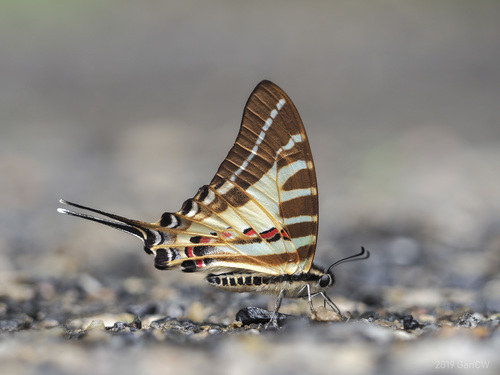
Graphium aristeus, originally described by Caspar Stoll, was first published in 1782. This butterfly's forewings are yellowish, with a dark brown outer region that holds a thin yellow stripe. Four dark brown stripes are the most prominent feature across the wing, and a dark brown area sits adjacent to the body. The underside of the forewings is very similar in appearance to the upper side. The hindwings are yellowish with long tails and a wavy edge. Their outer region is dark brown and contains a chain of yellow spots, while the inner edge is dark brown. A dark brown stripe runs through the middle of the hindwing. The underside of the hindwings is very similar to the upperside, except that a chain of red spots is the dominant feature across the wing. The entire body is black, including the thorax and head. The underside of all body parts is yellow. Graphium aristeus occurs in the Australasian and Indomalayan realms, and is widely distributed in New Guinea. Recorded localities in the Papua region include: Salawati Mountains on Salawati; Wardo on Biak; and Akimuga (Kampong Baru & Fafafuku), Beaufortbivak, Dabra (Mamberamo), East Tami, Homasam, Kobakama, Kopi River (Timika), Kuala Kenkana (Timika), Van Weels Camp (Keerom), Wendesi, and Werba (Fakfak) on New Guinea. External to the Papua region, its distribution includes Northern India, Sikkim to South China, the Philippines, Indonesia, New Guinea, Queensland, New Britain, New Ireland, and Manus.