About Graphium antiphates (Cramer, 1775)
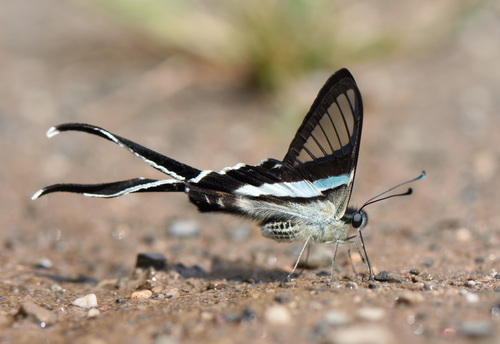
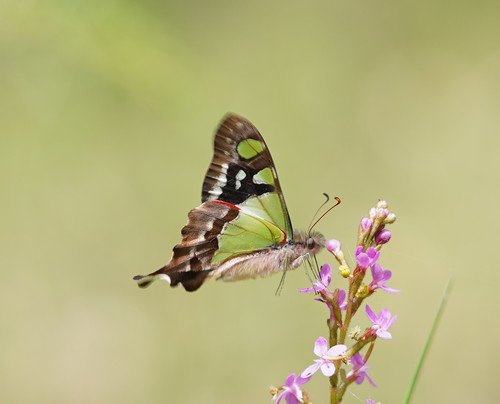
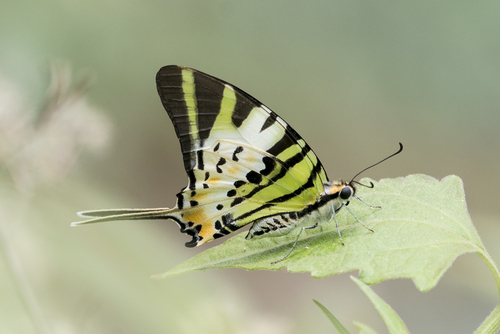
This is a morphological description of Graphium antiphates (Cramer, 1775). On the upperside of both males and females, the base ground colour is white. The forewing's cell is crossed by five short black bands: the basal band extends to the dorsum, the sub-basal band extends into interspace 1, the medial and pre-apical bands reach up to the median vein, and the fifth apical band runs along the discocellulars. This final apical band extends broadly on both sides of the veinlets and ends at the lower apex of the cell. Beyond these five bands are broad postdiscal and terminal black transverse bands that run from the costa to the tornal angle. The two bands merge below vein 4 and end in a point at the tornus. The anterior white portions of the cell are overlaid with pale green; short broken glossy green bands sit between the black cellular apical band and the discal band, and anteriorly between the discal band and the terminal band. On the upperside of the hindwing, the basal three-quarters is uniformly white, and black markings from the underside show through this white area. The terminal fourth is dark grey, crossed by a curved, irregular subterminal series of black crescent-shaped marks that ends in a black tornal spot, plus a terminal black band that follows the wing's indentations. The emargination (notches in the margin) below the black tornal spot is edged with ochraceous. The tail is blackish grey, edged and tipped with white. The underside of the forewing has similar markings to the upperside, but the green shading over the white portions in the basal half of the cell is more distinct. The discal and terminal transverse black bands are separate and not joined posteriorly; the former is edged posteriorly on both sides by dark grey, caused by the black on the upperside showing through by transparency. On the underside of the hindwing, the basal half is green and the outer half is white. It has a large black tornal spot, a black line along the dorsum that curves outwards above the tornal spot to vein 2, a straight subbasal black band running from the costa across the cell that terminates on vein 2, where it joins the dorsal black line, a broader black band from the costa across the apex of the cell that extends into the base of interspace 3, an irregular discal series of black markings curved inwards posteriorly toward the tornal spot, a subterminal series of very small slender black lunules arranged in pairs, where the ground colour on the inner side of these lunules is darkened to rich ochreous yellow, and finally a series of short terminal black bars in the interspaces, arranged to follow the indentations of the termen. The tail is dusky black and edged with white. The antennae are black; the head and anterior thorax have a broad black medial band, the rest of the thorax is bluish; the abdomen is white, marked beneath on each side by a black stripe. Race alcibiades, Fabr. is the most widely distributed race of G. antiphates, and differs from the typical form as follows. On the upperside of both males and females, all black markings are shorter and narrower. On the forewing, the discal and terminal bands are separate; the former rarely extends below vein 3, and the latter does not reach the dorsal margin in any studied specimen. On the hindwing, the broad grey area on the terminal margin is reduced to a small grey patch at the apices of interspaces 2 to 4; black subterminal markings are rarely present anteriorly, and are generally confined to the grey patch. On the underside, black markings are similarly reduced in extent, and are otherwise identical to the typical form. The width and length of the transverse black markings on the forewing upperside, as well as the extent of the grey terminal area and the presence or absence of black subterminal markings on the hindwing upperside, are all highly variable. Form nebulosus, Butler, is a melanistic variety recorded from Sikkim. Variety continentalis, Eimer, has black suffusion on the caudal area of the hindwing upperside. Variety itamputi, Butler, has the postdiscal and terminal black bands on the forewing upperside united posteriorly, but neither band extends all the way to the tornus. Variety ceylanicus, Eimer, has the basal two bands on the forewing upperside extended beyond the median vein, and the preapical cellular band is not triangular and extends to the median vein.