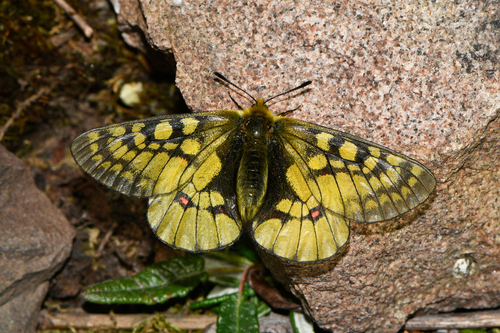
About Graphium antheus (Cramer, 1779)
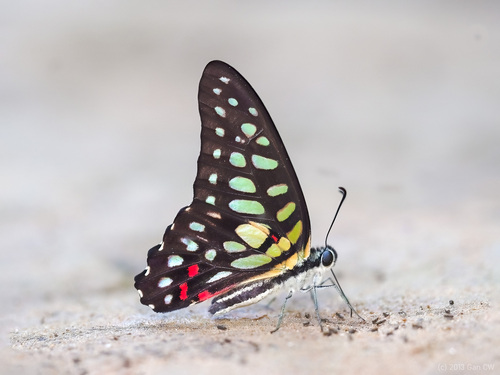
This species, Graphium antheus (Cramer, 1779), has a wingspan of 65–70 mm for males, and 70–75 mm for females. For the typical form, all transverse bars in the forewing cell are separated. The apical spot in the cell of the upper hindwing is completely separated from the cell's median band by black ground colour. The middle cell of the underside of the hindwing has a deep black and red spot. The larva is brown to brown-green with a yellow belt on the third segment, and feeds on Artabotrys, a genus in the Annonaceae family. The typical form ranges from Sierra Leone to Angola.
Aberration evombaroides Eim., found in West Africa, is otherwise identical to typical G. antheus except that the apical spot of the cell on the upper hindwing is more or less united with the median band.
Aberration utuba Hamps., recorded from Delagoa and British East Africa, is otherwise consistent with nyassae. In this form, the fourth and fifth transverse bands in the forewing cell are united posteriorly, forming a U-shaped spot.
Subspecies or form nyassae Btlr., distributed from Natal to British East Africa, has separated transverse bars in the forewing cell, but lacks the black and red spot in the middle cell of the underside of the hindwing.
Aberration or variety lurlinus Btlr., found in Nyassaland and the area around Victoria Nyanza, is somewhat larger than typical G. antheus, and has more extended green markings on the wing upperside. In particular, the transverse bars in the forewing cell and the submarginal spots of both wings are nearly twice as large as in the typical form.
mercutius Sm. & Kirby, recorded from Delagoa Bay, has yellowish white markings on the upper wing surface. The second and third transverse bands, and the fourth and fifth transverse bands, are each united to form a large, almost quadrate spot. The hindwing has a red spot in cell 1c and cell 2 on both surfaces, and also has a red dot in cellule 7 on the underside. Unlike the typical form, the hindwing cell has no red or black spot. Only one specimen of this form is known, and it may be only an aberration of a female nyassae.