About Graphium angolanus (Goeze, 1779)
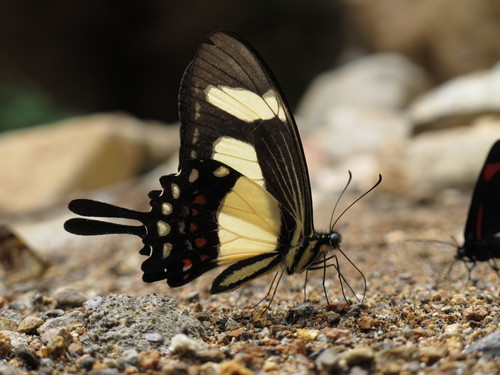
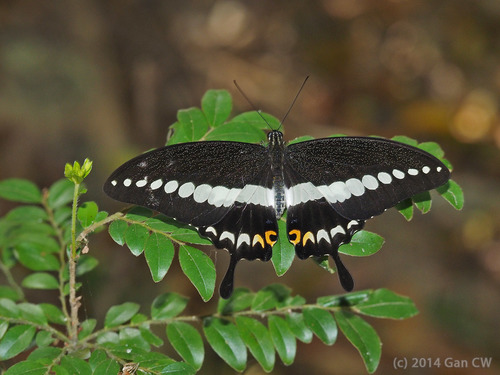
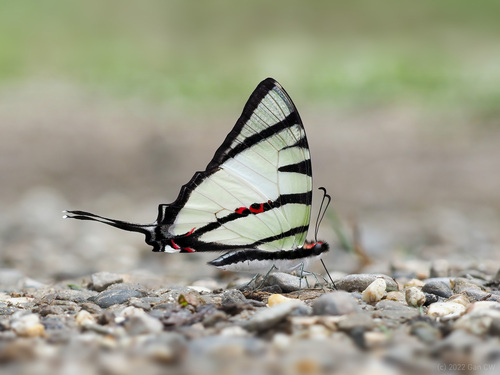
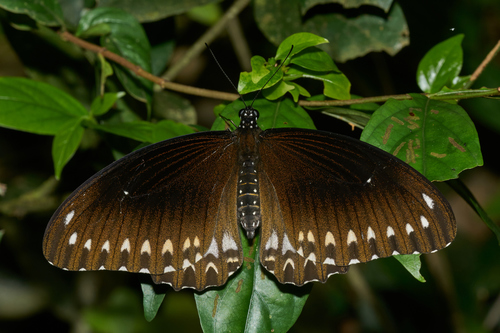
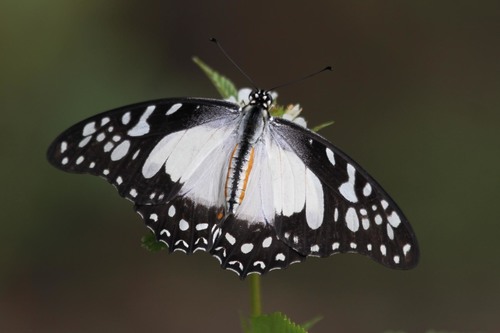
Graphium angolanus (Goeze, 1779) has a wingspan of 65–70 mm in males and 70–75 mm in females. Its hindwings are tailless, with angled extremities at the veins. The frons bears a white or red dot or streak on each side, and the palpi are white. The upper surfaces of the wings are patterned with white and black; the underside of the wings is red or red-brown at the base. All species in this group share the same white ground pattern on the underside of the wings. On the forewing underside, this pattern includes eight submarginal spots positioned close to the margin; nine discal spots across cellules 1a to 8 (of which the spots in cellules 5, 6 and 8 are almost always small and double); and four transverse spots or bands within the cell. On the hindwing underside, there is a broad white transverse band that extends at least to vein 2 at the costal margin, covers almost the entire cell, and is separated from the white inner marginal area of lb by a dark longitudinal streak in cellule 1c. Within its broad dark submarginal band, the hindwing has six submarginal spots (the spots in cellules 1–4 are sometimes divided), and 3–4 subdiscal spots in cellules 2–5; these spots can also be double and arranged in two rows. The hairs of the inner marginal fold on the hindwing of males are long and yellowish white.
Diagnostic features: The apex of the forewing cell has two white spots, one at the upper angle and one at the lower angle. The underside of the hindwing has no red spots within the marginal band, and both wings have white spots in the marginal band on their upper surfaces. The discal spot in cellule 3 is either entirely absent, or small and completely free, not reaching the base of the cellule. The forewing cell either has no white hindmarginal spot, or only a very small one. The abdomen has a broad yellow lateral stripe on each side.
This species occurs from the Congo region southwards to Natal and eastwards to British East Africa. The aberration lapydes Suff. differs from typical G. angolanus only by having a hindmarginal spot on the forewing cell, which extends as far as vein 3; this aberration is found in Kilossa, German East Africa. The full-grown larva has two widely separated spines not only on the first and penultimate segments, but also on the second and third segments. The long hump on the mesothorax of the pupa slopes obliquely forwards, and extends almost to the tip of the head. External images are held by the Royal Museum of Central Africa.