About Graphium agetes (Westwood, 1841)
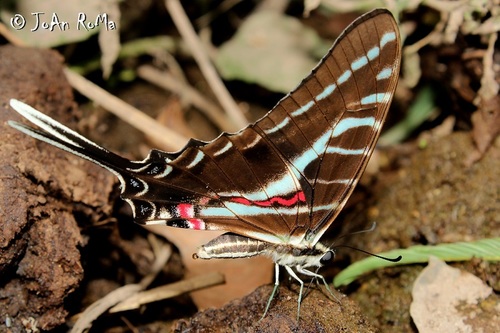
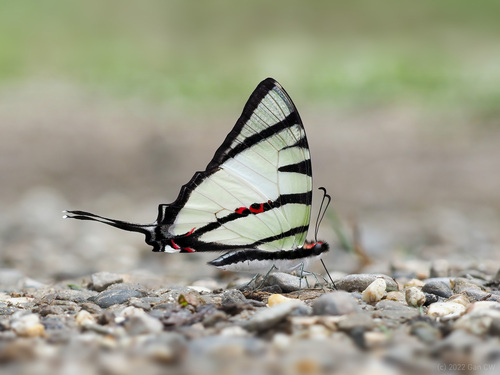
The upperside of both male and female Graphium agetes is white. On the forewing, the cell is crossed by three relatively broad oblique black bands. The innermost band extends across interspaces 1 and 1a to the dorsal margin, the middle band reaches vein 1, and sometimes extends a short distance further into interspace 1a, and the outermost band reaches the median vein. After these three bands, there is a triangular black costal spot above the upper apex of the cell. An oblique postdiscal band, similar in appearance to the three previous bands, extends from the costa to just above the tornus, where it connects to a broad black terminal border that runs between the wing apex and the tornus. The costal margin is bordered by a thin black line that widens slightly beyond the postdiscal band. The white base colour in the anterior half of the cell, in the area from the cell apex to the postdiscal black band, and in the area between the postdiscal and terminal bands, is hyaline (glass-like) with a greenish-yellow tint. On the hindwing, the tornal angle spot, anal lobe, tail, and terminal margin are black. Above the tornal spot is a short, relatively broad red band, which is bordered on its anterior side by a thin black line that connects the tornal spot to the black colouring of the anal lobe. Faint white scales are visible on the black terminal margin. There is a triangular transverse subterminal white spot in interspace 3, and occasionally a short subterminal white line in interspace 4. The anterior edge at the base of the tail also has a faint marking of white. When viewed by transparency from the underside, two converging transverse black bands can be seen; the outer of these two bands is crossed by short transverse red lines in interspaces 2, 6, 7, and 8. The underside pattern matches the upperside pattern, with the addition of the two previously mentioned black bands on the hindwing, which merge together above the tornal area. The antennae, head, thorax, and abdomen are black. The head has red markings, the sides of the thorax have greyish pubescence, the abdomen has lateral white stripes, and the underside of the body is white. Karl Jordan, in Seitz (on page 87), published a description that distinguishes G. agetes from closely related taxa and discusses some of its forms.