About Graphium agamemnon (Linnaeus, 1758)
Scientific name: Graphium agamemnon (Linnaeus, 1758)
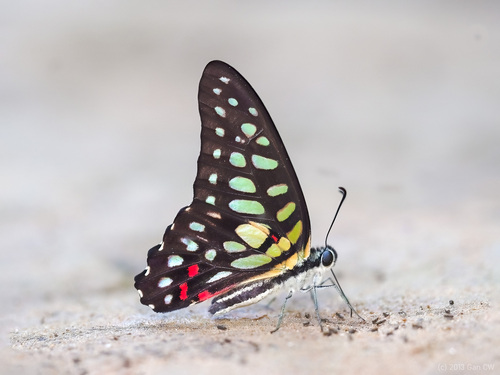
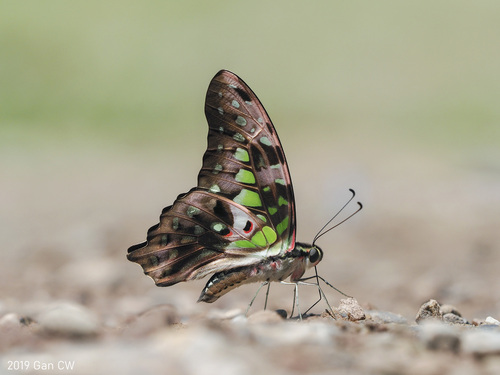
Description: Males have a black upperside. On the forewing, green markings include: a spot at the extreme base of the costal margin, a short transverse bar near the base of the cell, and seven spots arranged two by two beyond the bar, with only the apical spot being single; two spots beyond the apex of the cell; a spot at the base of interspaces 1a and 1, followed by two oblique short macular bands; a discal series of spots that decrease in size toward the costa, and a postdiscal series of smaller spots that begins with two spots in interspace 1; the spots in interspace 7 in both series are out of line, positioned further outwards.
The hindwing has three series of similarly green transverse markings that run more or less parallel to the dorsal margin; the upper markings in interspace 7 are white, and there is a short greenish stripe at the extreme base of the wing.
The underside is fuliginous (sooty) brown or brownish black, with more or less extensive pink suffusion along the forewing costal margin, apical area, and outer margin of the discal markings; on the hindwing, pink suffusion is broad along the dorsal and terminal margins and at the base of interspaces 6 and 7. Markings on the underside are similar to those on the upperside, but less clearly defined and somewhat more grey in tint. The hindwing has black, inwardly red-margined spots placed over the pink area in interspaces 6 and 7. Cilia are very narrow and pale pink. Antennae, head, thorax, and abdomen are black; the upper side of the thorax and the sides of the abdomen are streaked with greenish grey. The underside is ochreous grey, with pink markings on the thorax.
Females are similar to males, but have a greenish white streak along the dorsal margin on both the upper and undersides.
The race decoratus occurs in the Andaman and Nicobar islands, and is very similar to the typical form. It can be distinguished by the following traits: upperside green spots are smaller, especially the discal series on the forewing. On the underside of the hindwing, the red postcostal spot is relatively small, but the red area is much larger compared to the black area; in addition to the large red anal mark and the mark before the first disco-cellular veinlet, there is a large red spot in the lower median cellule (interspace 2), a smaller red spot in each of the three preceding cellules (interspaces 3, 4, 5), and a streak-like spot at the base of the lower median cellule.
Range: Southern India to Saurashtra, northern India from Kumaon to Assam, Nepal, Sri Lanka, Andamans, Nicobars, Bangladesh, Brunei, Myanmar, Thailand, Laos, Cambodia, Indonesia, Vietnam, Singapore, southern China including Hainan, Taiwan, Japan (Ryukyu Islands), South East Asia extending to New Guinea, Bougainville, Solomon Islands, and Australia (northern Queensland).
Habitat: Once found primarily near wooded country with fairly heavy rainfall, the tailed jay is now very common at low elevations and regularly seen in gardens and urban areas. This shift is due to its food plant, Polyalthia longifolia (false ashoka or mast tree), being widely planted as an ornamental tree.
Life cycle: This species takes 33–36 days to develop from egg to adult. It is multivoltine, producing at least seven or eight broods per year.
Food plants: Species from multiple plant families are recorded as food plants, including Polyalthia longifolia, Polyalthia cerasoides, Annona squamosa, Annona reticulata, Annona discolor, Annona muricata, Goniothalamus cardiopetalus, Mitrephora heyneana, Uvaria narum, and Artabotrys hexapetalus of the family Annonaceae; Michelia doltospa, Michelia champaca, and Milliusa tomentosum; Cinnamomum spp.