About Grantiella picta (Gould, 1838)
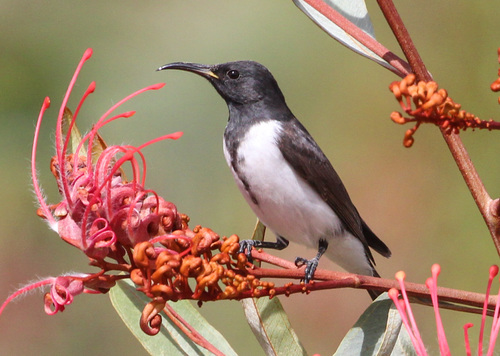
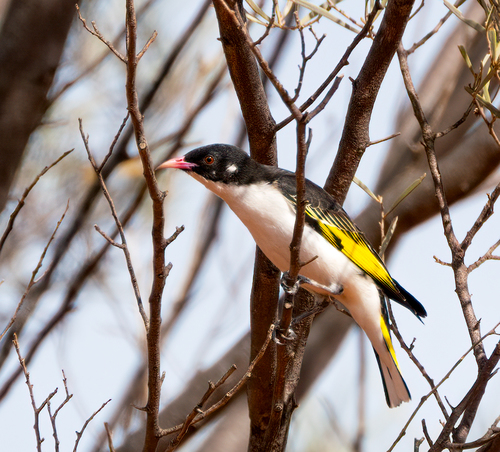
The painted honeyeater (Grantiella picta) is a small bird. It weighs approximately 20–25 g, reaches a total length of around 16 cm, has an average wingspan matching this length, an average tail length of 5.5 cm, and an average bill length of 1.3 cm. For adult males, the face, crown, and upper body (including the scapulars, nape, and rump) are black, with small white spots on each side of the head. The underside of the body (including the chin, throat, breast, and belly) and the underside of the tail are white. Black spots may appear among the white feathers on the flanks, breast, and belly. The edges of the black flight feathers, greater primary coverts, and greater secondary coverts are bright yellow; the edges of tail feathers are also bright yellow, and tail feathers have white tips. Striking color contrast on the remiges and rectrices is one of the species’ most distinctive features, along with its pink bill that has a grey tip. The feet and legs are grey, and the irises are reddish-brown. Females are slightly smaller than males, paler in color, and have fewer spots along the flanks. Juveniles are even paler than females, appearing more brown than black, with fainter yellow feather coloring and a grey bill instead of the pink bill of adults. This species is endemic to Australia, found across eastern and northern parts of the country. During spring and summer, its distribution ranges from inland central Victoria, through scattered areas across most of New South Wales and the Australian Capital Territory, and into southern Queensland. During winter, the birds migrate north to north Queensland (around Cape York Peninsula) and eastern areas of the Northern Territory. There have also been reported sightings in far eastern South Australia. Painted honeyeaters are found predominantly in woodlands and forests containing Eucalyptus and Acacia species. Their movement patterns are not fully understood, but they have been linked to the presence of mistletoe, which acts as their food source. Their north-south migration is thought to be driven by the availability of mistletoe berries at different times of year. Studies indicate that painted honeyeaters are more numerous in habitat areas that have experienced less fragmentation and land clearing. They are also more abundant in locations with a large number of trees and a high percentage of canopy cover. The painted honeyeater is a nomadic, highly elusive species. Sightings are rare; when observed, they are most commonly seen as pairs or single individuals, and less frequently in flocks.