About Grammatorcynus bilineatus (Rüppell, 1836)
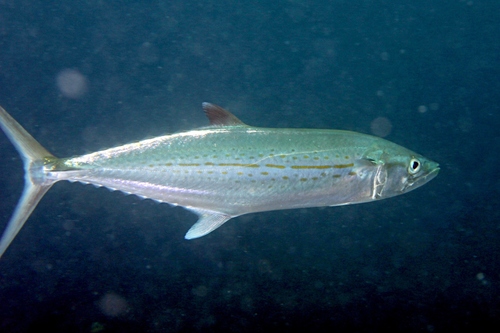
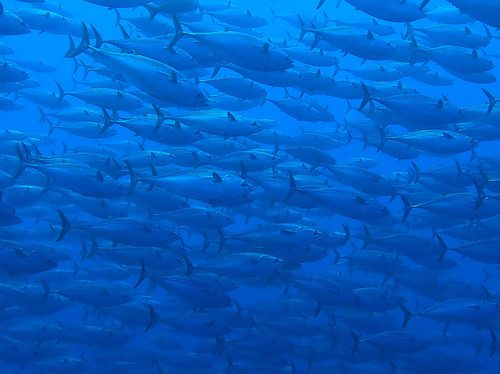
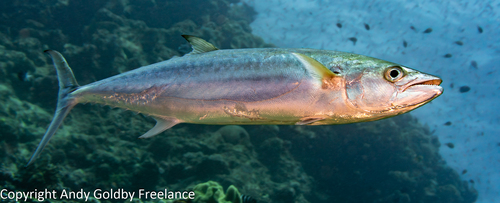
The double-lined mackerel, Grammatorcynus bilineatus (Rüppell, 1836), has an elongated, slightly compressed body covered in small scales, a relatively small mouth, and large eyes. Like other members of the Scombridae family, this species lacks a swim bladder. Its dorsal side is dark blue, its sides are silvery, and its belly is silvery white. It has 11–13 dorsal spines, 10–14 dorsal soft rays, and 10–14 anal soft rays, with relatively short pectoral fins. A distinctive feature of this species that sets it apart from most other fish is that it has two lateral lines per side of the body: one along the dorsal profile, and the other at the height of the pectoral fins. This species reaches a maximum total length of around 100 centimetres (39 in), with a common mature length of around 50 centimetres (20 in), and a maximum recorded weight of around 3.5 kilograms (7.7 lb). Double-lined mackerel are often confused with their close relative Grammatorcynus bicarinatus, the shark mackerel. They can be told apart because double-lined mackerel have no spots on their belly, are generally smaller in size, and have larger eyes than shark mackerel. This species is found in tropical and subtropical waters of the Indo-Pacific, ranging from the Red Sea to the Andaman Sea, from the northern coast of Australia to the Ryukyu Islands, and extending as far east as Fiji. Double-lined mackerel are subtropical, reef-associated pelagic fish. They typically live in open water, but are most commonly found in shallow waters between 15 and 50 metres (49–164 ft) deep. They feed primarily on crustaceans and fish, especially clupeiforms including Sardinella and Thryssa species, and also consume other fish such as triggerfishes (genus Balistes) and small barracudas (genus Sphyraena). This species usually forms large schools.