About Grammatophyllum speciosum Blume
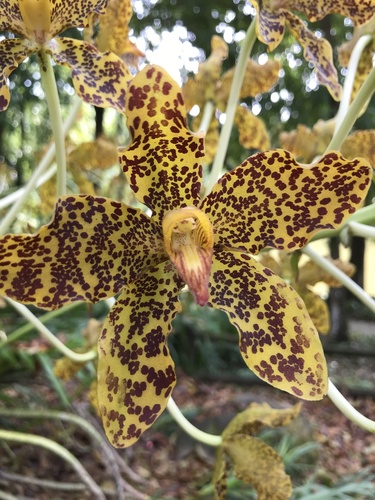
Grammatophyllum speciosum Blume is typically epiphytic, and occasionally lithophytic, that grows into spectacular root bundles. Its cylindrical pseudobulbs can reach up to 2.5 meters in length. It forms extremely large clusters that can weigh anywhere from several hundred kilograms to over one tonne. One specimen, collected near Penang Island in Malaysia by Frederick K. Sander & Co. in 1893, weighed exactly 1 ton (0.98 long tons; 1.1 short tons). Half of this collected specimen was sent to the 1893 Columbian Exhibition in Chicago, while the other half was sent to the Singapore Botanic Garden. By 1902, the Singapore specimen had grown to 14.4 meters (47 feet) in girth and 3 meters (9.8 feet) in height, and simultaneously produced 2,090 open flowers 12.5 cm (4.9 inches) wide, colored gold and mahogany, plus another 1,110 unopened buds. More recently, in 2000, biologists Tim Laman and Phil Atkinson found a G. speciosum in Borneo that measured 7.7 meters (25 feet) wide and bore between 2,500 and 5,000 flowers. This plant had completely encircled its host tree 46 meters (151 feet) above the ground. G. speciosum also includes the oldest known individual orchid plant. This individual was planted in the Singapore Botanic Garden in 1861 by Garden Director Lawrence Niven and his staff, and was 154 years old in 2015, measuring 5 meters (16 feet) wide. Each of its racemes can grow up to 3 meters tall, holding up to 80 flowers that each measure 10 cm wide. The flowers are yellow with maroon or dark red spots. These flowers have an unusual structure: the lowest flowers on the inflorescence do not have a lip, and these modified flowers act as osmophores for the entire inflorescence. They continuously release chemical scents to attract pollinators as other flowers open in succession. This orchid only blooms once every two to four years, but it can stay in bloom for up to two months, and individual flowers can remain fresh for as long as six weeks. Research has found that this plant has potential medicinal benefits; a 2013 study by Harikarnpakdee and Chowjarean found that G. speciosum specifically aids in wound healing in humans. This species is native to New Guinea, Thailand, Indonesia, Malaysia, and the Philippines. It grows in the crotches of large trees in exposed areas of lowland tropical rainforest. A giant two-ton G. speciosum was one of the featured attractions at the 1851 exhibition held at the Crystal Palace in London. Due to its extremely large full size, it is rarely cultivated, as it is usually too big to fit in most greenhouses. All cultivated specimens of this species are grown as terrestrials, even though wild plants can grow as epiphytes or terrestrials in their natural habitat.