About Grallina cyanoleuca (Latham, 1802)
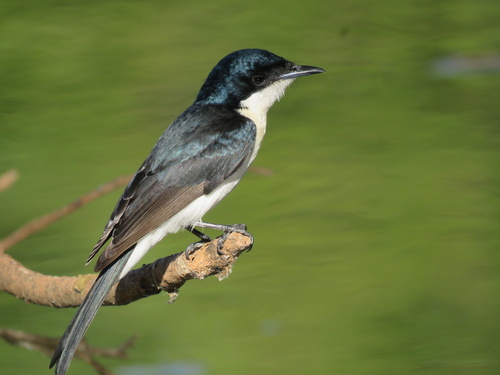
The magpie-lark, scientifically named Grallina cyanoleuca, is a small to medium fully grown bird that measures 25 to 30 cm (9.8 to 11.8 in) in length, around the same size as a European common blackbird. It has bold contrasting black and white pied plumage. Male magpie-larks weigh between 63.9 to 118 g (2.25 to 4.16 oz), while females weigh 70 to 94.5 g (2.47 to 3.33 oz). From a distance, males and females look similar, but they are easy to distinguish at close range: females have a white throat, and males have a black throat and a white eyebrow. Juvenile and immature birds of both sexes share the female’s white throat, the male’s black eyestripe, and a white belly. This species is common and very widespread across both urban and rural areas. It occupies almost all of Australia, with the exception of Tasmania and parts of the inland desert in the far north-west of Western Australia, and it has adapted well to living alongside humans. It is also naturally found in southern New Guinea and on the island of Timor. In 1924, magpie-larks were introduced to Lord Howe Island, which lies 600 km (370 mi) east of Australia in the Tasman Sea, and the species is now widespread across the island. The magpie-lark is a well-known sight across Australia; it can often be seen perched alone or in pairs on telephone wires, or foraging across open patches of bare ground, particularly on foreshores or in swamps. It has only been recorded once as a vagrant in New Zealand. Magpie-larks are primarily carnivorous, feeding on a wide variety of small creatures. They can adapt to a huge range of different habitats, and only require three key resources: some soft, bare ground for foraging, a supply of mud to build their nest, and a tree to place their nest in. The spread of agriculture has greatly benefited this species. Clearing dense forest in fertile regions and providing artesian water in arid areas, which have harmed many other species, have created ideal conditions for open-ground, short-grass feeders like magpie-larks and magpies. Loose gatherings of dozens of magpie-larks have been observed, with individuals perched together on elevated vantage points. Magpie-larks often perch near houses and on fences to mark their territory and search for mates. This behaviour is common across rural and suburban environments, but their loud, frequent high-pitched shrieks can be frustrating for suburban residents. These gatherings can be related to pairing or breeding, or they may simply indicate an area with abundant food. Magpie-larks are aggressively territorial, and will fearlessly defend their territory against larger bird species including magpies, ravens, kookaburras, and even wedge-tailed eagles. They also attack humans to defend their nesting sites. While their attacks on people are less aggressive than those of masked lapwings and magpies, they can still cause surprise or minor injury. They also frequently attack mirrors, windows, and other reflective surfaces, because they mistake their own reflection for an intruding rival entering their territory.