About Grallaricula nana (Lafresnaye, 1842)
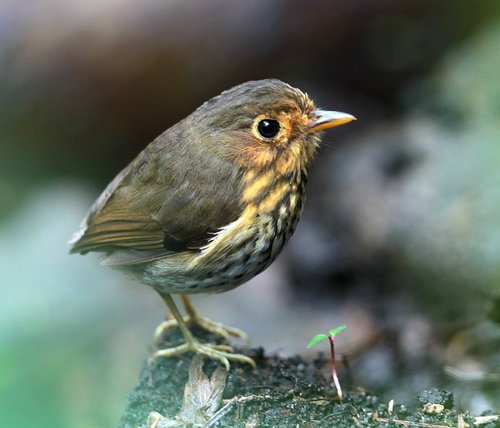
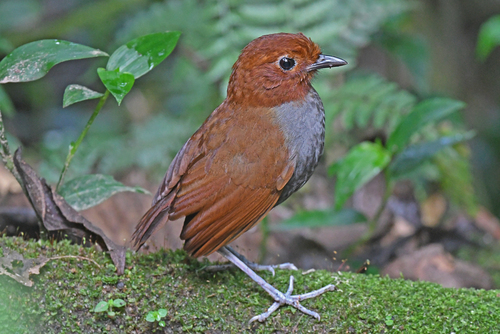
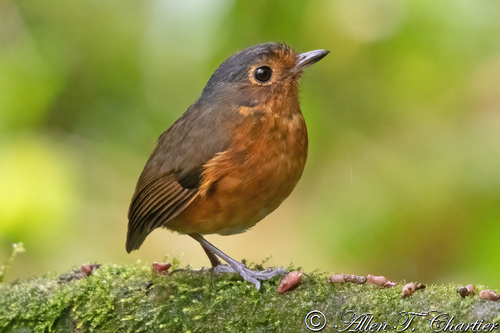
Grallaricula nana, commonly called the slaty-crowned antpitta, is a member of the very small genus of Andean antpittas Grallaricula, which are mostly found in low dense vegetation such as treefall gaps, stream edges, and bamboo thickets. Adult slaty-crowned antpittas measure 10.5 to 11.5 cm (4.1 to 4.5 in) long and weigh 17.5 to 23 g (0.62 to 0.81 oz). Both sexes have identical plumage. For the nominate subspecies G. n. nana, adult males have an orange rufous loral spot and eyering on an otherwise olive brown face, a dark slaty gray crown, dark olive brown upperparts and tail, dark tawny brown wings, and mostly orange rufous underparts with a white crescent across the lower throat and a white center to the belly. The species' other subspecies differ from the nominate and each other as follows: G. n. occidentalis has paler underparts than the nominate; G. n. hallsi has a more olivaceous back and paler, more orange underparts than the nominate; G. n. nanitaea has a more olivaceous back and paler breast than the nominate; G. n. olivascens is paler than the nominate with a more greenish olive back; G. n. kukenamensis has an ash gray crown, paler ochraceous brown upperparts, and paler underparts than the nominate. All subspecies of slaty-crowned antpitta have a brown iris, a black bill with a white or pinkish base to the mandible, and gray legs and feet. The ranges of the slaty-crowned antpitta's subspecies have not been completely resolved, and the species has a highly disjunct distribution. As of late 2023, the confirmed known distribution of subspecies is: G. n. occidentalis is found in Colombia's Central and Western Andes, and extends south along the eastern Andean slope through Ecuador into Peru, reaching the Marañón River in the Department of Cajamarca; G. n. nana is found in Colombia's Eastern Andes; G. n. hallsi is found in Serranía de los Yariguíes, in Santander Department of northeastern Colombia; G. n. nanitaea is found in the Sierra Nevada de Mérida in northwestern Venezuela, ranging from Trujillo state to Táchira state; G. n. olivascens is found in the Venezuelan Coastal Range, in Aragua state and the Capital District; G. n. kukenamensis is found in the tepui region of Venezuela's Gran Sabana state and the vicinity of Mount Roraima in western Guyana. Though the above distribution notes do not mention it, the South American Classification Committee of the American Ornithological Society holds records of G. n. kukenamensis in Brazil. The slaty-crowned antpitta inhabits montane forest in the subtropical to temperate zone, and it is almost always found in and near dense stands of Chusquea bamboo. Its elevation range varies by location: between 2,200 and 2,900 m (7,200 and 9,500 ft) in Peru, between 2,000 and 2,900 m (6,600 and 9,500 ft) in Ecuador, between 2,000 and 3,300 m (6,600 and 10,800 ft) in Colombia, and between 700 and 2,800 m (2,300 and 9,200 ft) in Venezuela.