About Grallaria saturata Domaniewski & Stolzmann, 1918
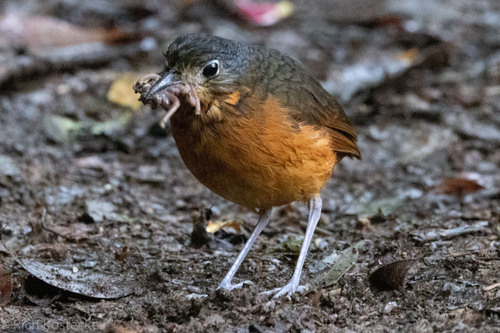
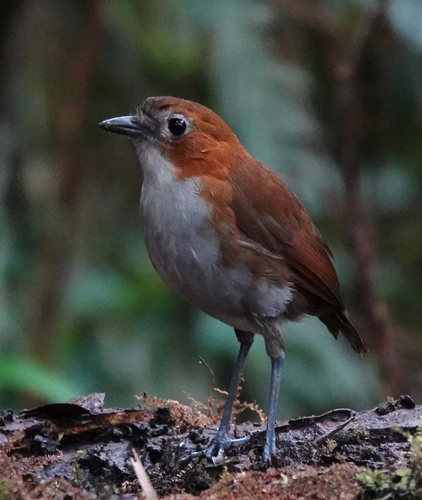
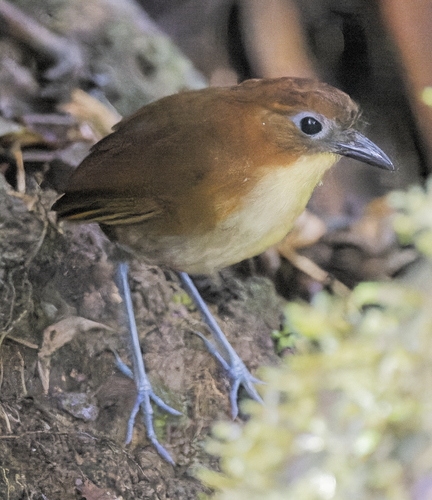
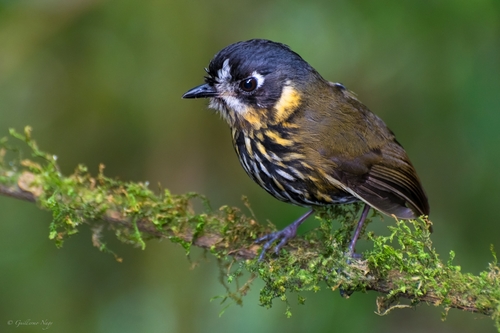
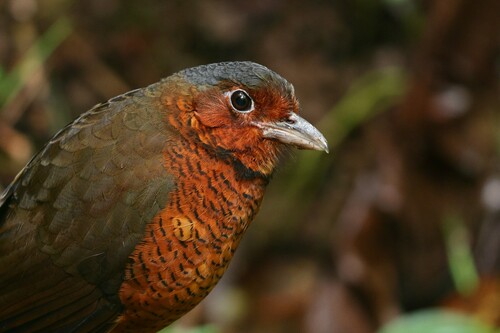
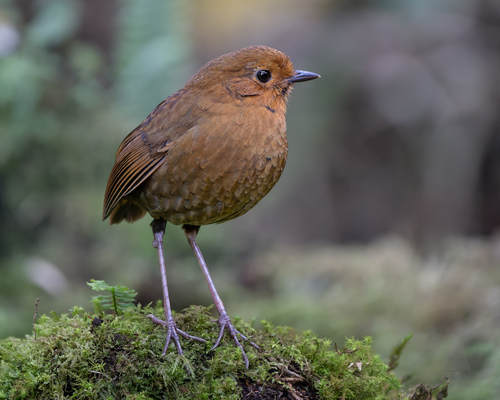
Grallaria, the antpitta genus, is described as a wonderful group of plump, round antbirds that often have fluffed-up feathers, stout bills, and very short tails. The equatorial antpitta (Grallaria saturata) measures 14.5 to 15 cm (5.7 to 5.9 in) long and weighs 32 to 47 g (1.1 to 1.7 oz). Males and females share identical plumage. Adult equatorial antpittas have mostly rufous-brown upperparts, with slightly more rufous coloration on the sides of the head. Their underparts are generally more rufous than their upperparts, with dark gray-brown flanks, a light rufous belly center, a buffy white to white vent, and whitish undertail coverts. Both sexes have a dark brown iris, a blackish bill with a paler base on the lower mandible, and grayish blue to vinaceous gray legs and feet. The equatorial antpitta is the most widely distributed species within the rufous antpitta complex. It has a disjunct range with two main populations divided by the Colombian Massif. The northern population occurs in Colombia's Central Andes, east of the Cauca River, with a small subpopulation located further east beyond the Magdalena River Valley in the Iguaque Massif. The southern population ranges along the western slope of Colombia's Eastern Andes, and extends south through both of Ecuador's Andean ranges into northern Peru, north of the Maranon River and east of the Huancabamba River in the departments of Cajamarca and Piura. It is geographically separated from the closely related Cajamarca antpitta (G. cajamarcae) by the Huancabamba and Marañón rivers, and from the Chami antpitta (G. alvarezi) by the Cauca River Valley. Equatorial antpittas inhabit the forest floor and understory in both the interior and edges of humid montane forests that are rich in moss and epiphytes. They can also be found in more open landscapes, including páramo adjacent to forest, forest trails, and bare landslides. Some authors note that the species favors boggy areas, seeps, and riparian corridors. Most of its range falls between 2,500 and 3,300 m (8,200 and 10,800 ft) in elevation, though there are documented records from as low as 2,200 m (7,200 ft) and as high as 3,900 m (12,800 ft).