About Grallaria ruficapilla Lafresnaye, 1842
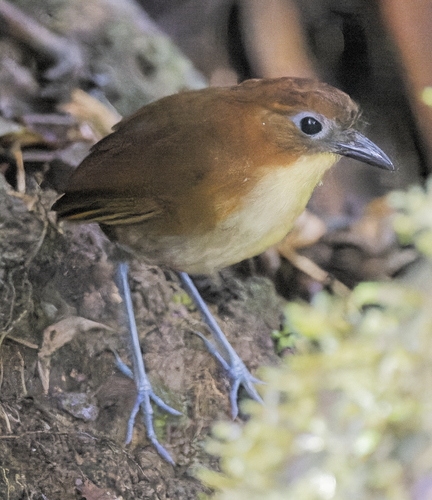
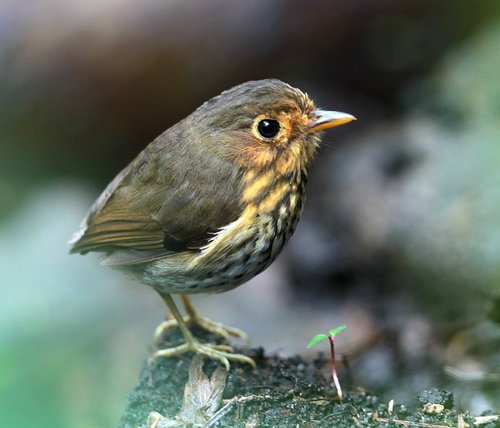
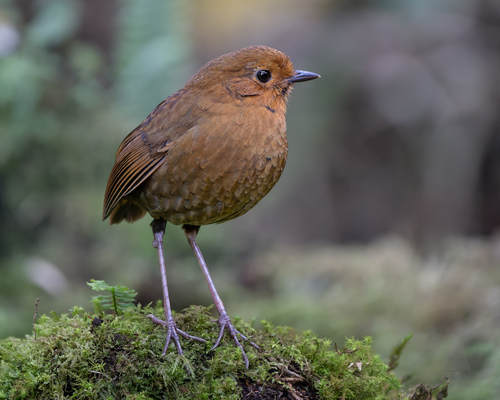
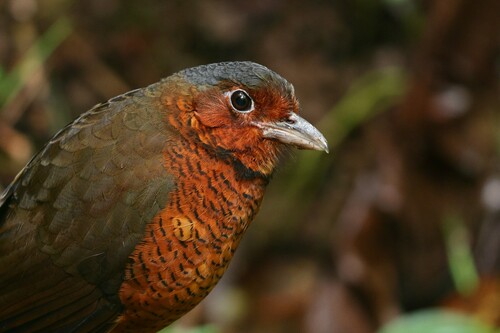
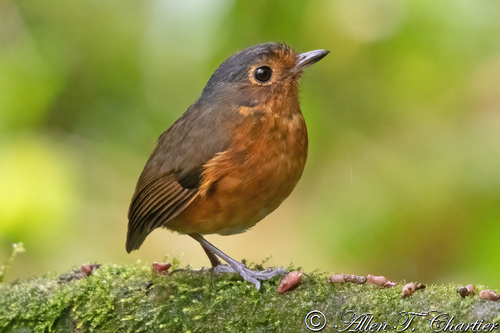
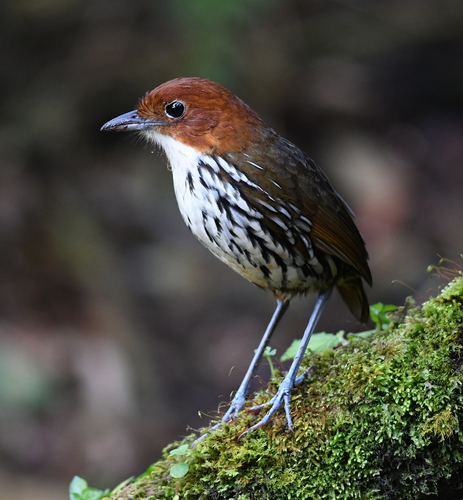
Grallaria antpittas, including the chestnut-crowned antpitta (Grallaria ruficapilla), form a distinctive group of plump, round antbirds that often hold their feathers fluffed up, with stout bills and very short tails. The chestnut-crowned antpitta measures 18 to 23 cm (7.1 to 9.1 in) in length and weighs 70 to 98 g (2.5 to 3.5 oz). Males and females have identical plumage. Adults of the nominate subspecies G. r. ruficapilla have a rufous crown, nape, and face. Their back, rump, tail, and wings are olivaceous. Their throat, breast, and belly are white; some breast feathers have ochraceous edges, and their sides (and sometimes their breast) have olivaceous and blackish streaks. The other recognized subspecies differ from the nominate and each other in the following ways: G. r. perijana has somewhat heavier and darker breast streaking than the nominate, though less streaking than avilae and nigrolineata, and an ochraceous-orange tint to its breast and upper belly. G. r. avilae has heavier and darker breast streaking than the nominate, along with a brighter crown and nape and paler greenish olive upperparts. G. r. nigrolineata has heavier and darker breast streaking than the nominate. G. r. connectens has lighter upperparts than the nominate, whitish lores, an olivaceous tint to its flight feathers, more fulvous underparts, and less heavy streaking. G. r. albiloris matches the nominate in most traits, but has white lores, a white "moustache" stripe, and some white on the ear coverts. G. r. interior has lighter, more brownish olive streaks on the breast, sides, and flanks than the nominate, and the center of its breast is more strongly orange-ochraceous. All subspecies have a brown or dark brown iris, a black bill with a gray base on the lower mandible, and pale blue-gray legs and feet. The chestnut-crowned antpitta has a disjunct distribution, with each subspecies occupying a separate range: G. r. ruficapilla is found across all three Andean ranges in Colombia, and extends south through Ecuador to the country's northern and central regions (not southwestern Ecuador). G. r. perijana occurs in Serranía del Perijá in extreme northern Colombia, ranging slightly into western Venezuela. G. r. avilae lives in the Venezuelan Coastal Range between Lara and Miranda states. G. r. nigrolineata inhabits the Andes of Venezuela between northern Trujillo and northern Táchira states. G. r. connectens is restricted to El Oro and Loja provinces in southwestern Ecuador. G. r. albiloris is found on the western slope of the northwestern Peruvian Andes, in Piura, Cajamarca, and Lambayeque departments. G. r. interior occurs in north-central Peru, in Amazonas and San Martín departments. This species occupies a wide variety of landscapes, including subtropical and tropical semi-humid and humid montane forest, open woodlands, and secondary forest. It can be found in unbroken forest interior, at forest edges, and in somewhat open areas within forest created by disturbances like fallen trees. It is strongly associated with Chusquea bamboo in areas where bamboo grows. It can also survive in some human-modified habitats, including areas of mixed pasture and scrubland. Its elevation range varies by country: it occurs between 1,200 and 3,000 m (3,900 and 9,800 ft) in Colombia, mostly between 1,900 and 3,100 m (6,200 and 10,200 ft) in Ecuador, between 1,200 and 3,100 m (3,900 and 10,200 ft) in Peru, and between 1,300 and 3,000 m (4,300 and 9,800 ft) in Venezuela.