About Grallaria milleri Chapman, 1912
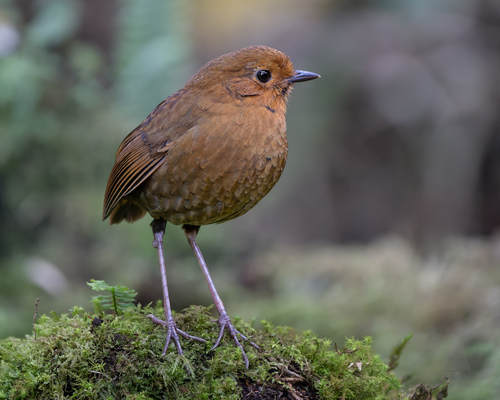
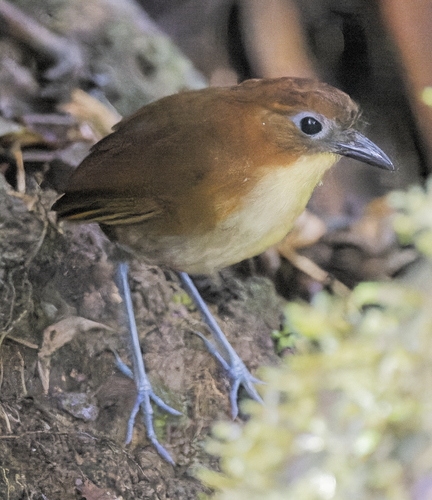
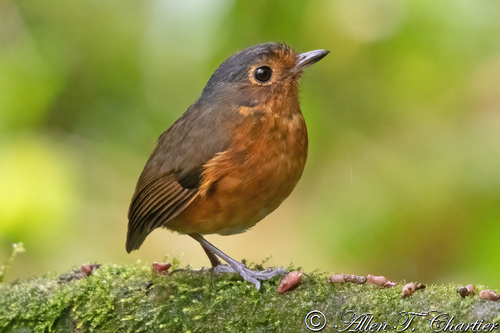
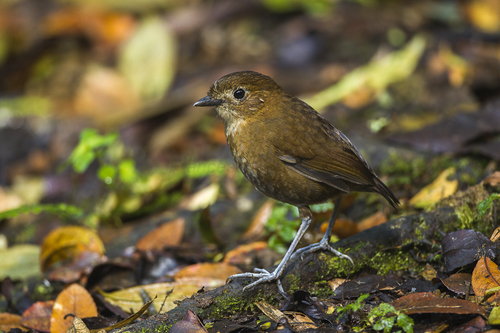
The brown-banded antpitta (Grallaria milleri Chapman, 1912) measures 13 to 18 cm (5.1 to 7.1 in) in length and weighs approximately 50 to 55 g (1.8 to 1.9 oz). Both sexes have identical plumage. Adult individuals have whitish lores marked with black speckles, and ochraceous brown ear coverts. The crown, nape, back, and uppertail coverts are a deep, rich raw umber, while the rump is slightly paler. The tail can be more rufescent or slightly more greenish than the back. The wings are generally similar in color to the tail, with dusky brown primaries and raw umber coverts. The throat is grayish white with tawny olive sides. The species has a wide tawny olive breast band, sides and flanks that tend toward olivaceous, a creamy white central belly, and undertail coverts mixed with gray and olivaceous. Subspecies G. m. gilesi is larger than the nominate subspecies, but is otherwise essentially identical in appearance. Both subspecies have a dark brown iris, a black bill with a paler tip, and slate gray to blackish legs and feet. The nominate subspecies of the brown-banded antpitta is distributed in the Central Andes of Colombia. It occurs from Caldas Department to Quindío Department on the western slope of the range, and in Tolima Department on the eastern slope. The only known specimen of subspecies G. m. gilesi was collected in Antioquia Department, and no additional records of this subspecies from the area exist. This species inhabits the temperate zone, in areas that are regrowing with Chusquea bamboo or alder trees (Alnus acuminata) after natural disturbance such as a landslide. Most of its population occurs at elevations between 2,700 and 3,200 m (8,900 and 10,500 ft), though there are records of individuals found as low as 1,800 m (5,900 ft).