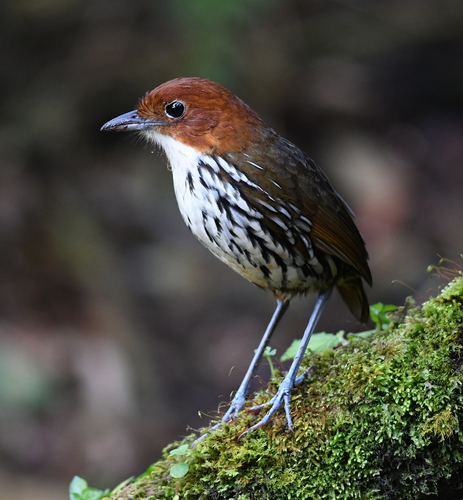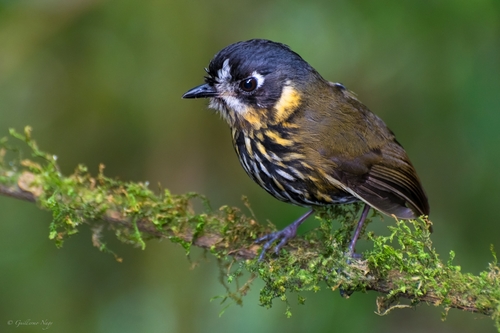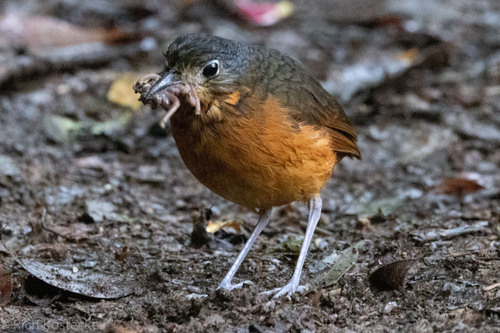
About Grallaria guatimalensis Prevost & Des Murs, 1842
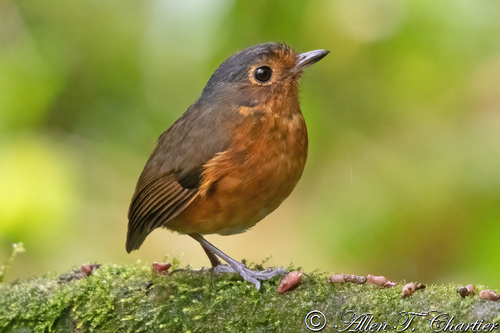
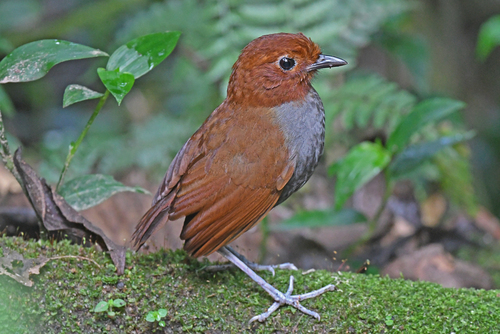
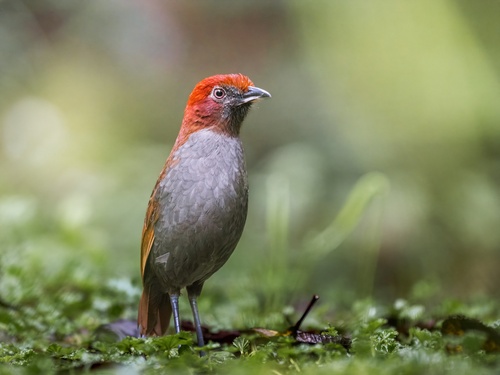
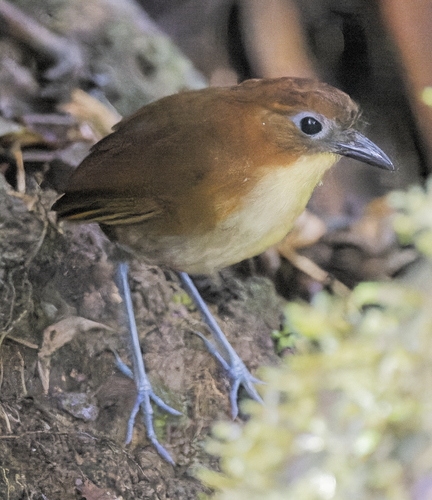
Grallaria antpittas, the group that includes this species, are a wonderful group of plump, round antbirds whose feathers are often fluffed up. They have stout bills and very short tails. The scaled antpitta, Grallaria guatimalensis, is 15 to 19 cm (5.9 to 7.5 in) long and weighs 70 to 98 g (2.5 to 3.5 oz). The sexes have identical plumage. Adults of the nominate subspecies G. g. guatimalensis have a pale olive-brownish forecrown with fine black scaling, and a gray crown and nape. They have whitish or buffy lores, olive brown ear coverts with thin streaks, and blue-gray skin around the eye. Their back and wing coverts are olive brown with black feather edges that create the scaled appearance that gives the species its common name. Their flight feathers and tail are light brown. Their throat is ochraceous- or tawny-brown with thin pale streaks, and wide ochraceous or buffy "moustache" streaks along its sides. They often have a paler, black-speckled "necklace" below the throat. Their underparts are tawny. All subspecies share the same physical traits: a dark brown iris, a black maxilla, a grayish mandible, and pinkish or bluish gray legs and feet. The other recognized subspecies differ from the nominate and each other in the following ways. G. g. binfordi is much paler than the nominate, with narrower scaling on the back. G. g. ochraceiventris is much paler than the nominate, with narrower scaling on the back. G. g. princeps has richer colors and heavier back scaling than the nominate. G. g. chocoensis is richer colored and darker than the nominate, with rusty lores and an olive cast to the crown and wings. G. g. regulus is the smallest subspecies; it has a buffy (not white) moustache, a dusky throat, a dark brown breast with pale tawny stripes, and a tawny belly and crissum. G. g. sororia is very similar to regulus, but has a whitish moustache, a grayer back, and paler underparts. G. g. carmelitae has darker and browner upperparts than the nominate, with brownish cinnamon underparts. G. g. aripoensis has richer overall colors than the nominate and lacks the "necklace" marking. G. g. roraimae has a somewhat grayer crown and nape than the nominate, with paler upperparts, some cinnamon-rufous coloring on the flight feathers, white or ferruginous throat streaks, and paler ferruginous underparts. The scaled antpitta has a highly disjunct distribution, with each subspecies occupying a separate range: G. g. binfordi occurs in south-central Mexico, in Mexico City and the states of Mexico and Morelos. G. g. ochraceiventris occurs in southern Mexico, between Jalisco and western Hidalgo, and from southern Guerrero to southern Oaxaca. G. g. guatimalensis occurs from Veracruz and Oaxaca in eastern and southern Mexico, south through Guatemala, El Salvador, and Honduras into northern Nicaragua. G. g. princeps occurs on both slopes in Costa Rica, extending into Panama as far as Veraguas Province. G. g. chocoensis occurs in Darién Province in eastern Panama and Chocó Department in northwestern Colombia. G. g. regulus occurs on the west slope of Colombia's Eastern Andes; in the Andes of western Venezuela between Táchira and Lara; and in southwestern Colombia, extending south through eastern and western Ecuador to central Peru, where it is mostly found on the east slope. G. g. sororia occurs from Peru's Department of Cuzco into central Bolivia's Santa Cruz Department. G. g. carmelitae occurs in northern Colombia, in the Sierra Nevada de Santa Marta and from Serranía del Perijá south into northern Boyacá Department. G. g. aripoensis occurs on Trinidad. G. g. roraimae occurs in the tepui area where southern Venezuela, central western Guyana, and northern Brazil meet; a population on Margarita Island may belong to this subspecies. A single scaled antpitta was captured in a mist net in Belize in 2024. The South American Classification Committee of the American Ornithological Society lists the scaled antpitta as a vagrant on Trinidad. The scaled antpitta inhabits a variety of landscapes in the upper tropical and lower temperate zones. These landscapes include humid evergreen forest, lowland rainforest, and pine-oak forest. It is almost always found on the forest floor, and usually favors areas with dense vegetation. In northern Central America it occurs in humid semi-deciduous forest, pine-oak forest, and cloudforest. In Costa Rica it occurs in wet montane forest. Its elevation range varies by region: it generally occurs between 500 and 3,000 m (1,600 and 9,800 ft) in Mexico and Central America, but only 800 to 1,600 m (2,600 and 5,200 ft) in Costa Rica. It occurs below 1,900 m (6,200 ft) in Colombia, between 350 and 2,400 m (1,100 and 7,900 ft) in Venezuela, mostly below 1,300 m (4,300 ft) but as high as 2,000 m (6,600 ft) in Ecuador, and between 650 and 1,750 m (2,100 and 5,700 ft) in Peru.