About Gracupica contra jalla (Horsfield, 1821)
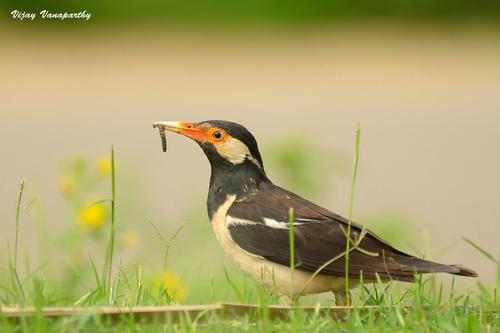
This subspecies of myna has striking black-and-white markings, a yellowish bill with a reddish base, and reddish bare skin around the eye. Its upper body, throat, and breast are black, while its cheeks, lores, wing coverts, and rump are contrasting white. Males and females have similar plumage; young birds have dark brown plumage instead of black. Subspecies of this group vary slightly in plumage, the extent of feather streaking, and body measurements. This myna has round wings and flies slowly with a butterfly-like movement. Leucistic individuals of this taxon have been recorded. The species occurs mainly in plains, and can also be found in foothills up to around 700 meters above sea level. It is mostly found in areas with access to open water. In India, its main range extends from the Gangetic plains south to the Krishna River. Its range is currently increasing; populations have become established more recently in Pakistan, Rajkot, and Bombay (since 1953), possibly helped by trade in caged birds and accidental escapes. Its westward spread across India, especially into parts of Rajasthan, has been aided by changes to irrigation and farming patterns. The species has also become established in the United Arab Emirates. It inhabits lowland open areas with scattered trees near water, and is often found near human settlements. This species is frequently seen at sewage farms and refuse tips.