About Gracula religiosa Linnaeus, 1758
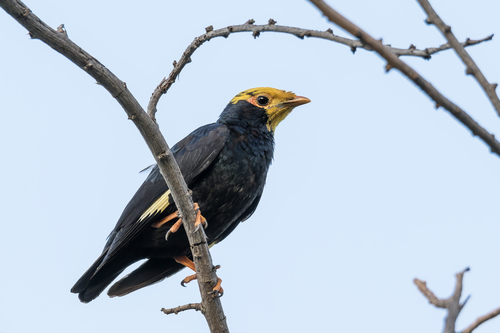
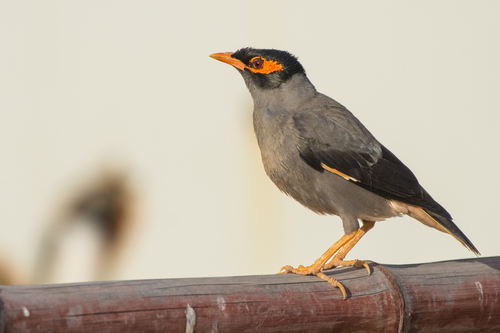
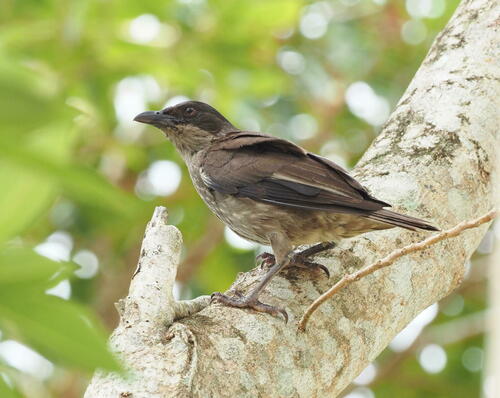
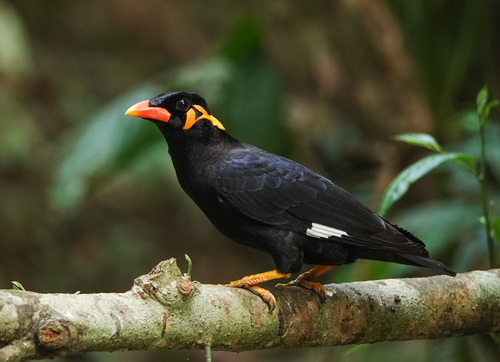
Gracula religiosa Linnaeus, 1758, commonly called the common hill myna, is a stocky, jet-black myna species. It has bright orange-yellow patches of bare skin and fleshy wattles on the sides of its head and nape. It reaches about 29 cm in length, making it somewhat larger than the common myna (Acridotheres tristis). Its overall black plumage has a green gloss, with purple tints on the head and neck. Large, white wing patches are clearly visible when the bird is in flight, but are mostly hidden when it is perched. Both its bill and strong legs are bright yellow, with additional yellow wattles located on the nape and under the eye. These wattles differ noticeably in shape from the bare eye patch found on common mynas and bank mynas (A. ginginianus). Wattle shape also varies subtly between different South Asian hill myna species: for common hill mynas, the wattles extend from the eye to the nape, where they join together; the Sri Lanka hill myna has a single wattle that crosses the nape and extends a short way toward the eyes; the southern hill myna has separate wattles that curve toward the top of the head; and the Nias myna differs in both facial wattle details and overall size, especially the size of its bill. Male and female common hill mynas are similar in appearance; juvenile individuals have a duller-colored bill. Subspecies of Gracula religiosa differ from one another in size, the pattern of head wattles, and the glossiness of plumage. A 2020 study found that the subspecies G. religiosa miotera likely qualifies as a separate distinct species, and was probably driven to extinction in the wild during the late 2010s due to unsustainable collection for the wildlife trade. The study recommends rescuing the last remaining genetically pure captive individuals to carry out captive breeding. The International Ornithological Congress currently tentatively recognises G. religiosa miotera as a subspecies of Gracula religiosa. This myna is a resident breeder whose native range starts in Kumaon division, India at 80° E longitude, extending east through Nepal, Sikkim, Bhutan, and Arunachal Pradesh, across the lower Himalayas, terai, and foothills up to 2,000 m above sea level. Its range continues east through Southeast Asia, northeast into southern China, and via Thailand southeast across northern Indonesia to Palawan in the Philippines. The species is virtually extinct in Bangladesh, due to habitat destruction and overexploitation for the pet trade. A feral population that lived on Christmas Island has also disappeared entirely. Introduced populations currently persist in Saint Helena, Puerto Rico, and possibly in mainland United States and other locations; feral populations need at least a warm subtropical climate to survive. This myna is almost entirely arboreal, moving in large, noisy groups of around half a dozen individuals in tree tops at forest edges. Unlike the characteristic jaunty walk of other mynas, this species hops sideways along branches. Like most starlings, the common hill myna is fairly omnivorous, feeding on fruit, nectar, and insects. It builds its nest inside a tree hole, and the usual clutch consists of two or three eggs. There is no sexual dimorphism in the species, which limits the selection of potential mates.