About Goura victoria (Fraser, 1844)
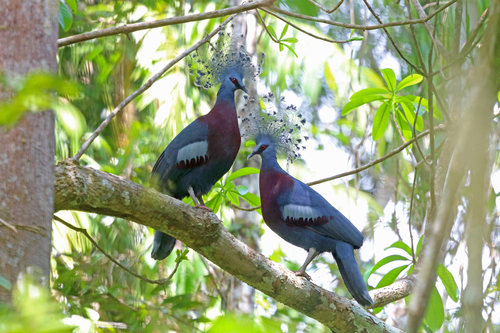
The Victoria crowned pigeon, scientific name Goura victoria (Fraser, 1844), has deep blue-grey plumage with a small black mask. Its signature feather crest, a defining feature of crowned pigeons alongside their large size, has prominent white tips. A row of paler blue-grey feathers with maroon tips runs along the wing coverts, forming a clear distinct wing bar. The chest of this species is colored deep purple-maroon. Melanism has been recorded in this species, as it has in all crowned pigeons.
The other two recognized crowned pigeon species are somewhat similar in superficial appearance. Only the western crowned pigeon shares an overlapping range with the Victoria crowned pigeon; Scheepmaker's crowned pigeon does not overlap in range. Western crowned pigeons have a more scraggly, hair-like crown, a uniform blue-grey chest rather than a maroon one, and a less distinct wing bar than Victoria crowned pigeons. Male and female Victoria crowned pigeons have similar appearances.
Victoria crowned pigeons typically measure 73 to 75 cm (29 to 30 in) in length. Some individual specimens exceed 80 cm (31 in) in length and 3.5 kg (7.7 lb) in weight. On average, this species is marginally larger than the other two crowned pigeon species, with a mean adult body mass of 2.39 kg (5.3 lb). It is therefore considered the largest surviving species of pigeon on Earth. Standard measurements for specimens from mainland New Guinea are as follows: wing chord 36–39 cm (14–15 in), tail 27–30.1 cm (10.6–11.9 in), bill 3.2–3.5 cm (1.3–1.4 in), and unfeathered tarsus 8.5–9.8 cm (3.3–3.9 in).
Like other crowned pigeons, Victoria crowned pigeons produce a loud clapping sound when they take flight. Their mating calls are similar to those of the other two crowned pigeon species, and consist of a repeated deep "hoota-hoota-hoota-hoota-hoota" sound. When defending their territories, these birds give a resounding repeated "whup-up, whup-up, whup-up" call. Their contact call is a deep, muffled sound rather similar to a human "ummm" or "hmmm".
There are two recognized subspecies of Victoria crowned pigeon. G. v. beccarii occurs on the mainland of New Guinea. The nominate subspecies, G. v. victoria, is found on the islands of Yapen, Biak and Supiori. The nominate subspecies is noticeably smaller, with a wing chord measurement of 31.6–33.2 cm (12.4–13.1 in). It also has less robust legs and feet, darker overall plumage, a sparser crest, and black markings on the wing coverts and just above the tail.
Victoria crowned pigeons inhabit lowland and swamp forests of northern New Guinea and surrounding islands. They usually occur in areas that were former alluvial plains, including sago forests. Though they are typically found at or near sea level, occasionally individuals may travel up into hills to elevations of around 3,000 feet.
Breeding for this species peaks late in the wet season and continues through the dry season. During courtship display for females, the male lowers his head, stretches forward, then rhythmically swings his head up and down while wagging his fanned tail. Although the female does most direct brooding work, both parents help raise the young. The female usually lays a single white egg in a sturdy tree nest built from stems, sticks, and palm leaves. In the weeks before laying, the male brings nesting material to the female. The egg is incubated for around 30 days. Young Victoria crowned pigeons leave the nest when they are still much smaller than their adult parents, but are actively cared for a total of 13 weeks after hatching.