About Gossypium barbadense L.
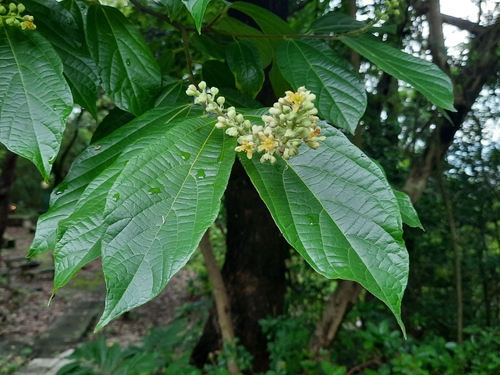
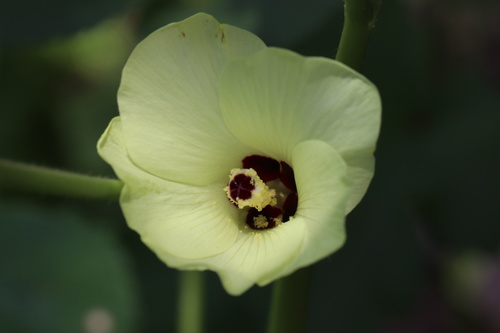
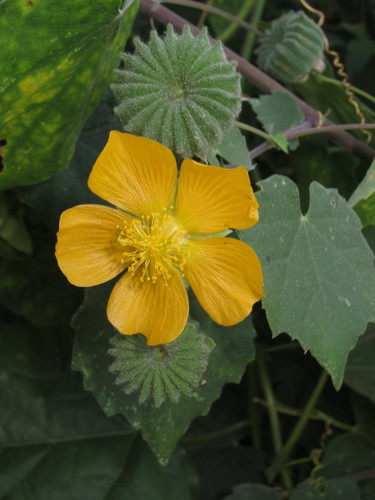
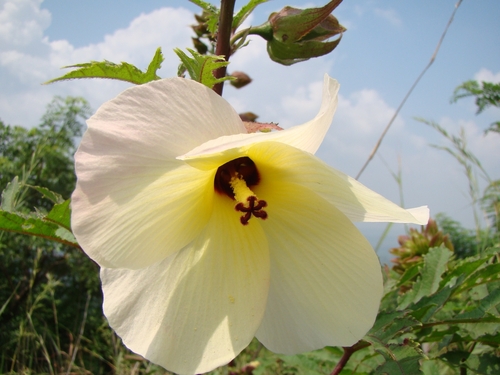
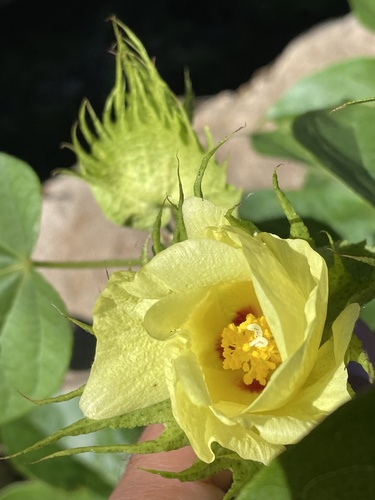
Gossypium barbadense L., like other cotton species, grows as a small bush in its first year. It is treated as an annual in cultivation, but if left unharvested, it can develop into a large bush or even a small tree reaching 1 to 3 meters in height. Its leaves are mostly 8 to 20 cm long, with between 3 and 7 lobes. One key difference between G. barbadense and the more widely cultivated G. hirsutum is that G. barbadense typically has 3 to 5 lobes, while G. hirsutum usually only has 3. The lobes of G. barbadense are also more deeply cut, extending roughly two-thirds of the leaf’s total length, compared to one half the leaf length for G. hirsutum. Cotton flowers are showy, with five petals that only open partially. Petals can grow up to 8 cm long, and are usually yellow. For Sea Island cultivars, petals are typically creamy yellow with a red spot at the base, and turn rose pink as they wither. Like other mallow family members, cotton flowers have many stamens that are merged into a cylinder surrounding the style. Seeds and fiber develop inside a capsule called a "boll". Each boll is divided into three sections, each of which produces 5 to 8 seeds. G. barbadense seeds are 8 to 10 mm long. Thousands of years of cultivation have dramatically altered the fiber of cotton plants. Wild cotton produces very little fiber — so little that it may go unnoticed. Fiber grows from each seed, and its natural function in wild cotton plants is unknown. Domesticated cotton produces far more fiber. In addition to the visible long fibers, domesticated cotton seeds have short fibers called "linters". Some G. barbadense cultivars have so few of these short fibers that they are often called "lintless", and are also referred to as "smooth-seeded", in contrast to the fuzzy-seeded G. hirsutum. As with all cottons, bolls open when they mature, revealing eye-catching "snowballs" of exposed fiber. All cotton species contain gossypol, though some G. hirsutum cultivars have been selectively bred to reduce levels of this compound. These low-gossypol cultivars are more susceptible to insect pests, suggesting that gossypol’s natural role is to deter pests. In agriculture, gossypol makes cotton plants poisonous to non-ruminant animals. Wild G. barbadense populations have been found in a small area near Ecuador’s Guayas Estuary, and on an island off the coast of Manta, Ecuador. The species can be grown as a perennial across the tropics, and is sensitive to frost. It can still be grown as an annual in regions with summers long enough to allow bolls to fully mature. Today, G. barbadense is cultivated worldwide, including in China, Egypt, Sudan, India, Australia, Peru, Israel, the southwestern United States, Tajikistan, Turkmenistan, and Uzbekistan. This species makes up approximately 5% of global cotton production. Certain regions specialize in G. barbadense cultivation, primarily to prevent hybridization between different cotton species. If a G. barbadense field is planted too close to a field of a different cotton species, the resulting fiber generally has poor quality. Most G. barbadense production comes from cultivars bred to produce particularly long fiber, and most of this fiber is used to make clothing. Long fiber is required to spin fine (thin) yarn, which is in turn needed to make intermediate products like lace and high thread-count cloth. Long-fiber G. barbadense cultivars also tend to produce especially strong fibers, making them useful for a range of industrial products. Historically, G. barbadense was used to make cords for automobile tires and cloth for aircraft wings, and it is also used for sewing machine thread. G. barbadense fiber is also used for some luxury goods, where its fiber qualities are less important than the reputation of premium-quality cotton. Sometimes, the same names used for market classes of cotton are also used for finished products. However, the reputations of the names "Egyptian cotton" and, to a lesser degree, "Pima cotton" have been damaged by finished items made from lower quality fiber. To address this issue, a group of American Pima cotton growers created the name Supima for finished products. This group of growers holds the trademark for the name, allowing them to enforce quality and origin requirements for all Supima-labeled products. Small areas of Tanguis and other short-fibered G. barbadense cultivars are grown for specialized purposes. G. barbadense can be used to produce cottonseed oil and animal feed, but other cotton species are generally preferred for these uses because G. barbadense seeds contain higher levels of the unwanted compound gossypol.