About Gorsachius melanolophus (Raffles, 1822)
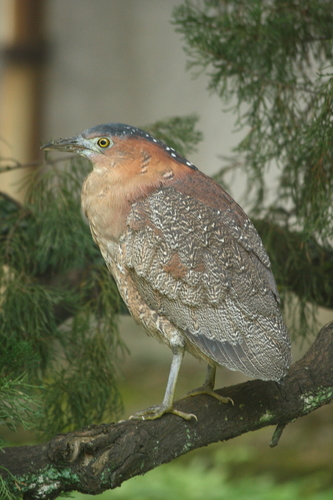
The Malayan night heron (scientific name Gorsachius melanolophus (Raffles, 1822)) measures about 48 cm (19 in) in length, with a wingspan of around 86 cm (34 in). It has a stocky build and a short beak. Its neck and breast are rufous, with streaks running down the center of the neck to the breast. The upperparts are chestnut and vermiculated, while the flight feathers are blackish. It has a black crown, white chin, yellow eyes, a black beak, and greenish legs. Juvenile Malayan night herons are greyish to rufous, with spotted and vermiculated patterning. During the breeding season, males have been reported to have deeper blue lores and a longer crest compared to females. Males develop dark blue lores 30 to 60 days before pair-bonding, while females have bluish-green lores when they first arrive in breeding areas. The lore color of both sexes fades as incubation progresses, changing from bluish-green to green to greyish-green. If pairs lay a second clutch, their lore coloration is duller than it was during the first clutch. The Malayan night heron is found in India, Sri Lanka, Brunei, Nepal, Bangladesh, Myanmar, Cambodia, Laos, Vietnam, Thailand, Malaysia, Singapore, China, Indonesia, the Philippines, Taiwan and Japan. It is a vagrant in Palau and Korea. Its total estimated range size is 1,240,000 km². One roadkilled individual has been found on Christmas Island, Australia, where the species is likely a vagrant. This bird lives in forests, along streams, and in marshes. In Japan, population densities of the herons increase as undisturbed forest cover on islands increases.