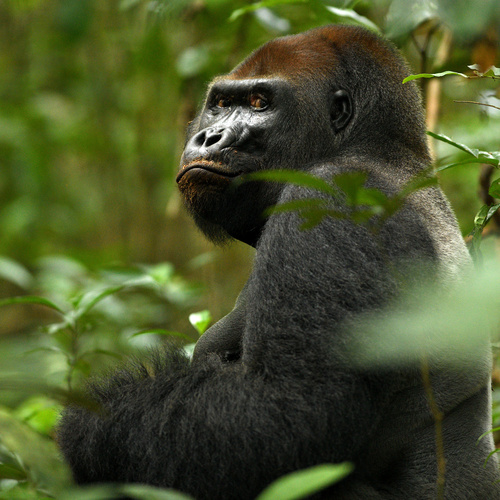
About Gorilla gorilla (Savage, 1847)
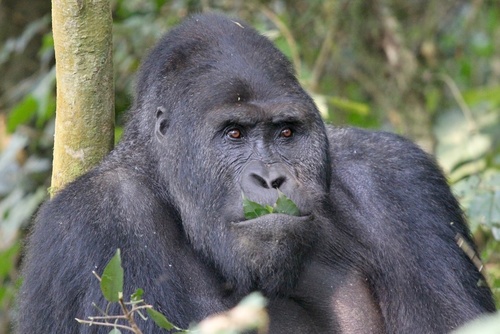
This entry covers the western gorilla, with the scientific name Gorilla gorilla (Savage, 1847). Western gorillas are generally lighter in color than eastern gorillas, with black, dark grey or dark brown-grey hair and a brownish forehead. Males have an average height of 1.67 metres (5.5 ft), and can reach up to 1.76 metres (5.8 ft) tall. Wild males weigh 145 to 191 kilograms (320 to 421 lb), while wild females weigh 58 to 72 kilograms (128 to 159 lb). Captive male western gorillas have an average weight of 157 kg (346 lb), and captive females average 80 kg (176 lb). One separate source records the average weight of wild male western lowland gorillas as 146 kg (322 lb). Cross River gorillas, a subspecies of western gorilla, differ from western lowland gorillas in skull and tooth dimensions.
Western gorillas live in social groups that range in size from 2 to 20 individuals. These groups include at least one male, multiple females, and their offspring. A dominant male called a silverback leads the group, and younger males typically leave the group once they reach maturity. Females transfer to a new group before starting breeding, which begins when they are 8 to 9 years old. Females care for their young infants for the first 3 to 4 years of the infants' lives. This long care period means birth intervals are long, which contributes to the species' slow population growth and makes western gorillas especially vulnerable to poaching. When combining long gestation, long parental care, and infant mortality, a female western gorilla only produces an offspring that survives to maturity every 6 to 8 years. Western gorillas are long-lived, and can live up to 40 years in the wild. A group's home range can be as large as 30 km2 (12 sq mi), but groups do not actively defend their home ranges. Wild western gorillas are known to use tools.
Western gorillas have a high-fiber diet that includes leaves, stems, fruit, piths, flowers, bark, invertebrates, and soil. How often each food type is eaten varies between gorilla groups and by season, and different groups eat different numbers and species of plants and invertebrates, which suggests western gorillas have a food culture. For western lowland gorillas, fruit makes up most of their diet when it is abundant, and this directly affects their foraging and ranging patterns. There is a correlation between how much time western gorillas spend traveling and the fruit availability season: they spend more time traveling and feeding when fruit is abundant than when fruit is scarce. Western gorillas prefer fruits from the genera Tetrapleura, Chrysophyllum, Dialium, and Landolphia. Lower-quality herbs, including leaves and woody vegetation, are only eaten when fruit is scarce. In the dry season from January to March, when fleshy fruits are uncommon, western gorillas eat more fibrous vegetation including leaves and bark from the low-quality herbs Palisota and Aframomum. Of the invertebrates western gorillas consume, termites and ants make up the majority. Caterpillars, grubs, and larvae are eaten only rarely.
Some ethnographic and pharmacological research has suggested that certain foods eaten by western gorillas may have medicinal value. Western gorillas eat the fruit and seeds of multiple Cola species. Since these foods are low in protein, their main purpose of consumption is likely the stimulating effect of the caffeine they contain. Western gorillas living in Gabon have been observed eating the fruit, stems, and roots of Tabernanthe iboga. This plant contains the compound ibogaine, which acts on the central nervous system to produce hallucinogenic effects, and also has effects similar to caffeine. There is also evidence that the seed pods of Aframomum melegueta, which are part of western gorillas' diet, have medicinal value, and may provide some cardiovascular health benefits for western lowland gorillas. These seed pods are already a known regular part of the natural diet of many wild western gorilla populations.
A 2007 study published the discovery that this species will fight back against potential threats from humans, with researchers recording several instances of gorillas throwing sticks and clumps of grass. This is unusual, because western gorillas usually flee when they encounter humans, and rarely charge. A mirror test conducted in Gabon found that dominant male silverback western gorillas react aggressively when they see their reflection in a mirror, but will not look directly at their reflection.