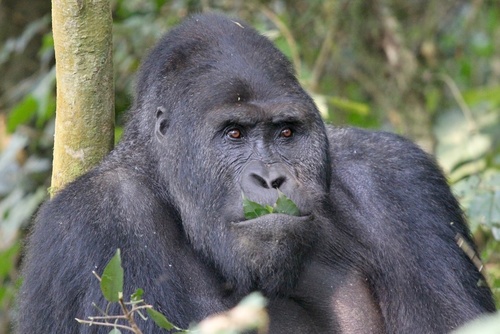
About Gorilla beringei Matschie, 1903
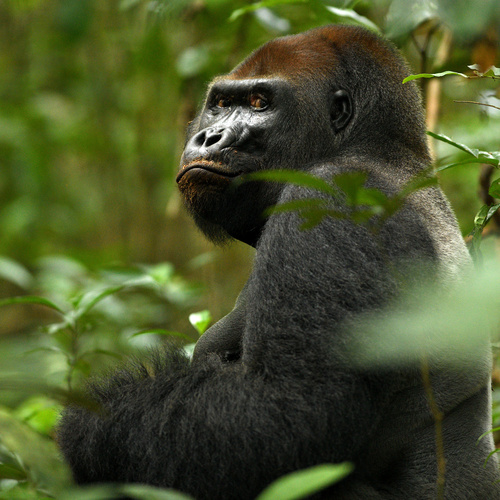
The eastern gorilla (scientific name Gorilla beringei Matschie, 1903) is a large hominid characterized by a large head, broad chest, and long arms. It has a flat nose with large nostrils, and its face, hands, feet, and breast are hairless. Most of its fur is primarily black, though mature adult males develop a silvery "saddle" patch on their backs. As male eastern gorillas age, the hair in this back saddle turns white, similar to the gray hair that develops in older humans; this trait is the origin of the name "silverback" for older mature males. The two subspecies differ in fur traits and size: Grauer's gorilla has shorter, thicker, deep black fur, while mountain gorilla fur has a more bluish tint. The mountain gorilla is slightly smaller and lighter than Grauer's gorilla, but it is still larger and heavier than both the western lowland gorilla and the Cross River gorilla. Across all eastern gorillas, males are much larger than females. A fully grown male eastern gorilla typically weighs 140–205.5 kg (309–453 lb) and reaches 1.7 m (5.6 ft) tall when standing upright, while a fully grown female typically weighs 90–100 kg (200–220 lb) and stands 1.5 m (4.9 ft) tall. The tallest recorded silverback was a 1.95-metre (6.4 ft) individual shot in Alimbongo, northern Kivu, in May 1938. The heaviest recorded gorilla overall was a 1.83-metre (6.0 ft) silverback shot in Ambam, Cameroon, that weighed 267 kilograms (589 lb); however, Ambam falls within the range of the western gorilla, far outside the known range of the eastern gorilla. In terms of distribution and ecology, mountain gorillas are only found in the mountain rainforest and subalpine forest of eastern Democratic Republic of the Congo (DRC), southwestern Uganda, and Rwanda. Grauer's gorillas live throughout the forests of the Albertine Rift in eastern DRC. Eastern gorillas are herbivorous, with a diet heavily based on foliage, which is a result of limited fruit availability in their native habitats. They have smaller home ranges than western gorillas, because foliage is more abundant than fruit in their environments. They are diurnal, and most of their foraging activity takes place in the morning and late afternoon. At night, they build nests by folding over vegetation, and most of these nests are constructed on the ground.