About Gorgonocephalus eucnemis (Müller & Troschel, 1842)
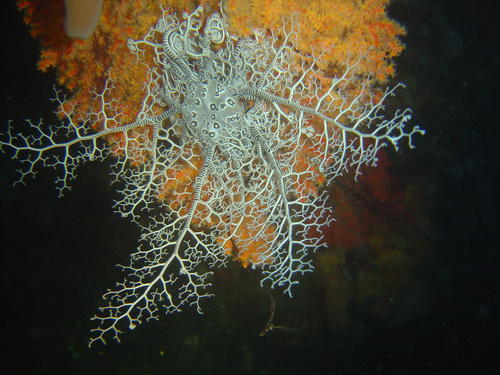
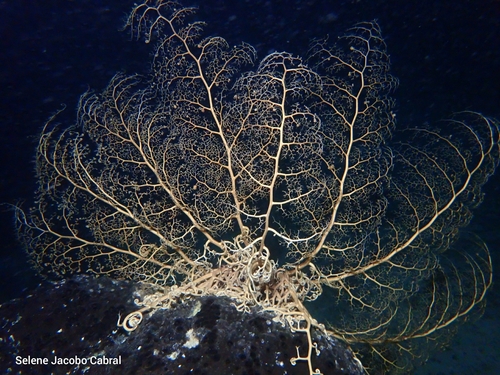
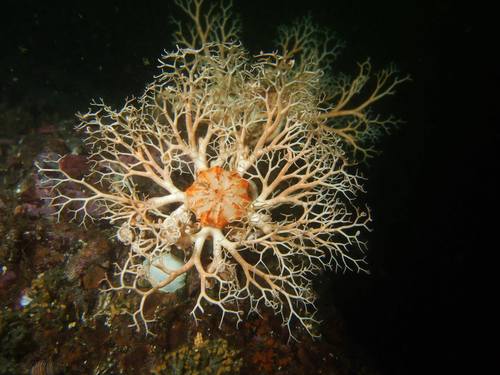
Gorgonocephalus eucnemis (Müller & Troschel, 1842) has a central disc that reaches up to 14 cm (5.5 in) across. It has five pairs of arms that branch dichotomously into increasingly smaller subdivisions. Its colour ranges across varying shades of white and beige, and often has a darker coloured central disc. This species has an endoskeleton made of calcified ossicles, and is covered by a fleshy layer of skin that gives it a rubbery appearance. Its arms are covered in tiny hooks and spines, which it uses to grip and manipulate food particles.
G. eucnemis is found in the Arctic Ocean and the northern Atlantic Ocean, ranging as far south as the Faroe Islands and Massachusetts. It also occurs in the Pacific Ocean, from the Bering Sea south to Japan and Laguna Beach, California. It is most often found in rocky areas with strong currents, at depths down to 2,000 m (6,600 ft), but is most common at depths between 15 m (49 ft) and 150 m (492 ft). It can also be found on mud and sandy seabeds among boulders, sea pens, and sea fans.
G. eucnemis is cryptic and stays well hidden during the day. It gains protection from the toxic nature of the sponges where it lurks, though it is sometimes eaten by fish and crabs. It has been observed returning to the same specific location on a regular basis. It often lives in association with sponges and soft corals in the genus Gersemia: it hides under these organisms or within the folds of host sponges during the day, and uses them as elevated platforms to search for prey at night. In Puget Sound, juvenile G. eucnemis have been found living and apparently feeding inside the pharynges of Gersemia rubiformis polyps, only emerging once they are large enough to fend for themselves.