About Gorgonia ventalina Linnaeus, 1758
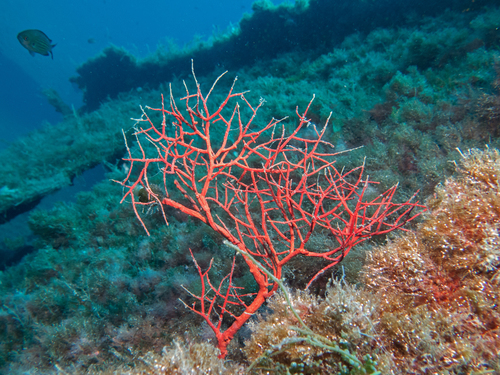
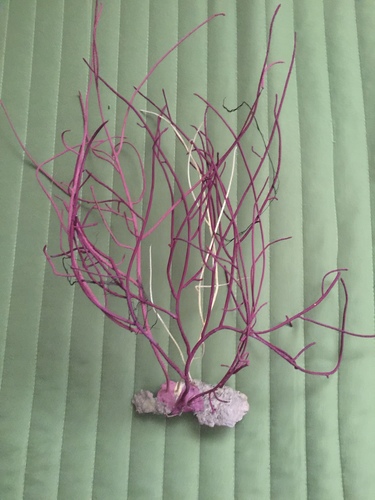
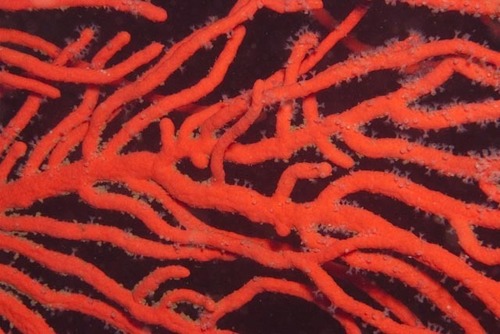
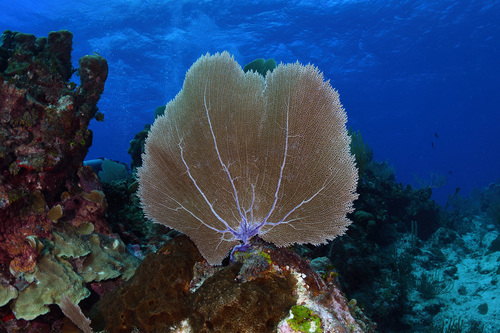
Gorgonia ventalina is a fan-shaped colonial coral with several main branches and a latticework of connecting smaller branches. Its skeleton is made up of calcite and gorgonin, a collagen-like compound. The calyces that hold the embedded polyps are arranged in two rows along the branches. Most smaller branches are compressed along the plane of the fan, a trait that distinguishes this species from the closely related Venus sea fan (Gorgonia flabellum). Small accessory fans often grow sideways out from the main fan. This coral can reach 1.5 m (5 ft) tall, and its color is variable: it may be whitish, yellow, or pale purple, with main branches often tinted purple. The entire fan grows oriented at a right angle to water currents. This species, commonly called the purple sea fan, is distributed in the western Atlantic and Caribbean, with its range extending from Bermuda, Florida, and the Gulf of Mexico south to Curaçao. It grows in shallow nearshore areas with strong wave action, and on deeper outer reefs with strong currents, at depths down to around 15 m (49 ft). G. ventalina is a filter feeder. Each of its polyps extends eight tentacles to catch plankton drifting by on water currents. Its tissues host symbiotic dinoflagellates of the genus Symbiodinium; these are photosynthetic organisms that produce organic carbon compounds from sunlight, which the host coral can use. The skeleton of G. ventalina contains hard, unpalatable structures called sclerites that deter predation. Its tissues also contain secondary metabolites that taste unpleasant to most predators. The nudibranch Tritonia hamnerorum is unaffected by these defenses, and is often found living in association with this coral. When feeding on G. ventalina, the nudibranch concentrates the coral’s metabolites in its own tissues, making itself unappetizing to its own potential predators. Specifically, T. hamnerorum sequesters the chemical compound julieannfuran from G. ventalina to use as a chemical predator deterrent. This coral is sometimes attacked by the fungus Aspergillus sydowii, which causes the disease aspergillosis. Infection leads to damaged patches, galls, tissue purpling, and even the death of the coral. Several mass outbreaks of aspergillosis have been recorded in the Caribbean, where corals living under stressful conditions, such as the low-salinity water of estuaries, are especially susceptible to infection. A parasite belonging to the class Labyrinthulomycetes and the family Thraustochytriidae causes similar damage, producing small damaged purple patches on the fan known as multifocal purple spots. A study conducted in the U.S. Virgin Islands found that G. ventalina has high ecological resilience; populations maintained their original densities after two major hurricanes hit the region in 2017.