About Gordonia lasianthus L. ex Ellis
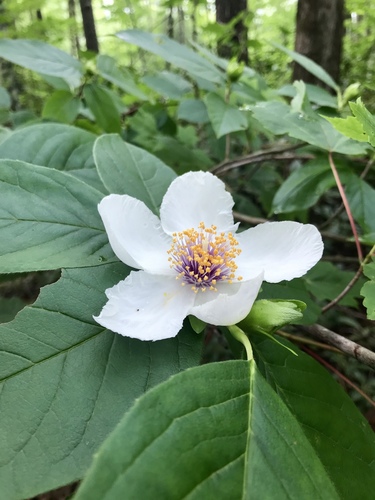
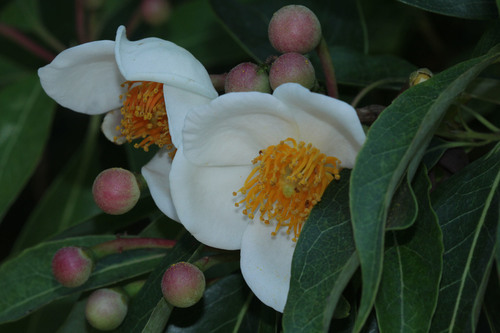
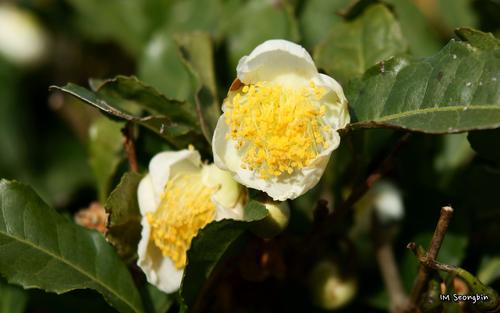
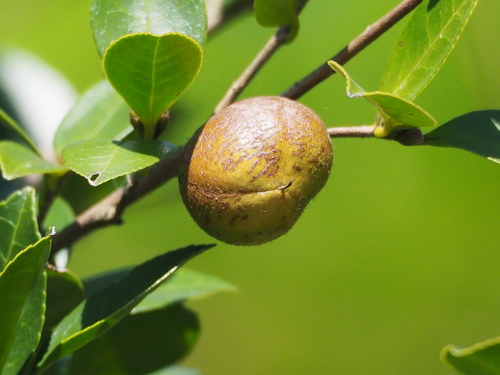
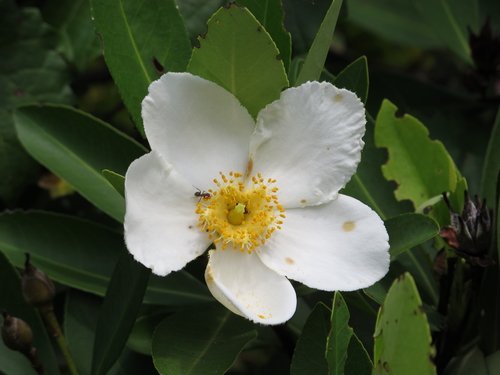
Gordonia lasianthus, commonly called loblolly-bay, holly-bay, gordonia, or bay, is a small to medium-sized evergreen tree or shrub. It grows in acidic, swampy soils of pinelands and bays across the Atlantic and Gulf Coastal Plains of the southeastern United States, and is a member of the tea family, Theaceae. It grows slowly, producing soft, light-colored fine-grained wood that ranges in color from cream to carmine. The wood has little commercial value, but loblolly-bay can be managed as a source of pulpwood. When older specimens are cut, their wood gives off a strong scent similar to a mixture of fresh oranges and pine sap. The bark of mature trees ranges from medium grey to red brown. Dead adult loblolly bay specimens develop a lustrous shine after being exposed to sunlight for several years. Its showy white flowers and shiny foliage make it a desirable ornamental plant, but it is not easy to cultivate. Deer heavily browse loblolly-bay stump sprouts. Loblolly-bay has a continuous native range along the Atlantic and Gulf Coastal Plains, from coastal southern Virginia to the Appalachicola River in the Florida Panhandle. Discontinuous populations also exist in Florida, the coastal counties of Alabama, the coastal counties of Mississippi, south and southeast Texas, and southern Louisiana. In South Carolina, it is common in the lower Coastal Plain, but restricted to specific sites in the middle and upper Coastal Plain. For sexual reproduction, Gordonia lasianthus produces perfect flowers. Flower bud formation becomes visible once new leaves are fully expanded. The peduncle expands rapidly, while the young bud enlarges slowly until opening. Flower buds at the top of the tree open first. Flowers first appear between the last week of June and the first week of July, and may continue to appear until mid-August. Flowers stay open for 1 to 2 days, and are pollinated by bumble bees, thrips, flies, and hummingbirds. After the second day, the sepals and petals fall off, leaving the ovary at the end of the peduncle. As ovaries develop, they gradually turn brown and develop five sutures. Mature, open capsules are first seen in September or October, and all capsules open by mid-December. Wind shakes seeds out of the open capsules, and empty capsules remain attached until peduncle and capsule abscission. Abscission first starts around the end of December and continues through the winter. Seedfall begins in October, peaks in December, and continues until March 1. Loblolly-bay seeds are winged and lightweight, with 120,000 to 151,000 seeds per pound, or 265,000 to 333,000 per kilogram. One study found that approximately 99 percent of all seeds produced fall within two tree heights of the parent tree. The seedfall distribution is concentrated near the parent tree: 60 percent of seeds fall within a distance equal to half the tree height, and 94 percent fall within a distance equal to the full tree height. Over a 2-year study, seedfall rates ranged from 2,600 to 273,000 seeds per hectare (1,070 to 110,400 seeds per acre). For seedling development, seed germination reaches 70 to 80 percent within 10 days when seeds are placed in petri dishes in sunlight. Similar germination percentages were seen in greenhouses heated to 13 to 16 °C (55 to 61 °F), but germination took up to 24 days. Germination is epigeal. Very few seedlings are observed in the wild, and most observed seedlings do not survive past their first season. Loblolly-bay seedlings appear to require relatively open conditions and exposed soil to successfully establish. Older seedlings have only been observed where mineral soil has been disturbed, such as in recently plowed fire lines. Initial seedling growth is slow. Field observations show that by the end of the third growing season, seedlings reach about 10 to 15 cm (4 to 6 in) tall, and by the eighth growing season they only reach 30 to 40 cm (12 to 15.5 in) high. For vegetative reproduction, horticulturists commonly propagate loblolly-bay from first-year shoots grown in a peat and sand medium under mist. In the wild, vegetative regeneration is more common than regeneration from seed. Stump sprouts can grow up to 1 m (3.3 ft) in the first year after a tree is cut. These stump sprouts are very attractive to deer, and heavy browsing is common. Numerous root-collar sprouts grow when trees are killed by fire, or when the root system is mechanically damaged by logging or disking operations. Loblolly-bay has long been used by horticulturists in landscaping, and most research on this species has been done by horticulturists focused on propagating it. In the U.S. Southeast, loblolly-bay is considered a handsome, hardy tree valued for its glossy dark-green leaves and abundant white flowers. Its wood has been used in cabinetmaking, and its bark has been used as a tanning agent. When bark is steeped in warm water, it dyes both the water and container a rich carmine color. Because it can grow in wet bogs and flats where loblolly pine does not grow well, managing loblolly-bay silviculture may be an alternative option for these areas. Recent laboratory papermaking tests and published results indicate that loblolly-bay has an acceptable pulp yield of 52 percent, produces paper with low bulk (1.46 cm/g or 2.53 in/oz), and has acceptable strength. One laboratory test recorded a breaking length of 11,525 m (37,812 ft), tensile strength of 10.2 kgf/15 mm (38.1 lbf/in), and 836 folds when tested with the Massachusetts Institute of Technology paper folding tester with a 1 kg (2.2 lb) weight. While further testing is needed, these tests do not show any issues with making kraft paper from loblolly-bay pulp. Pulp mills in the lower Coastal Plain of South Carolina already include loblolly-bay in their hardwood pulp mixes.