About Gopherus polyphemus (Daudin, 1801)
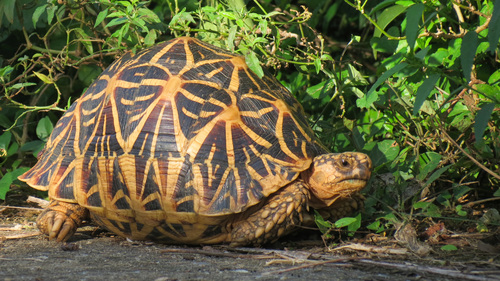
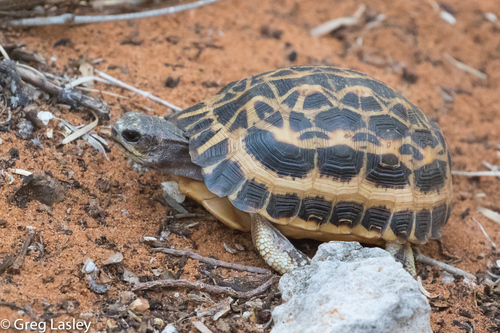
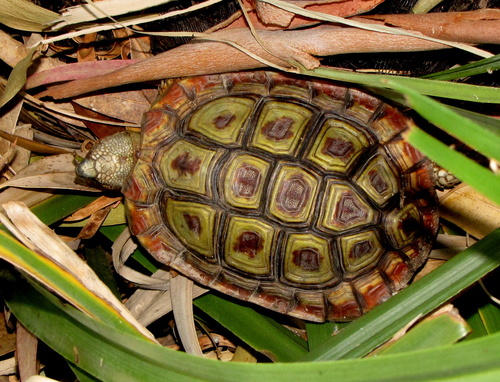
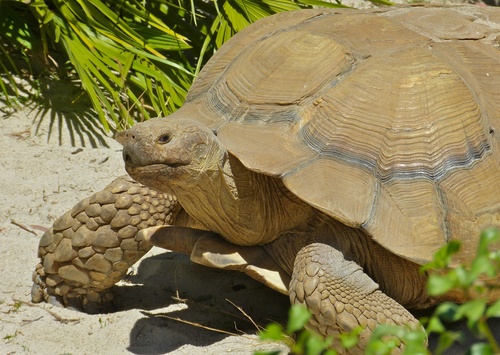
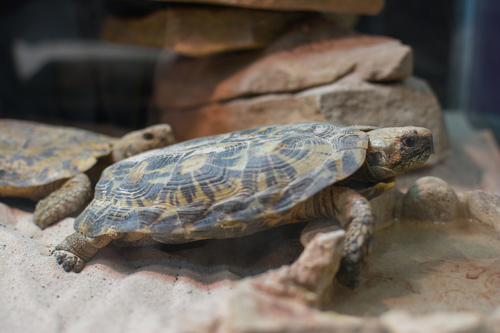
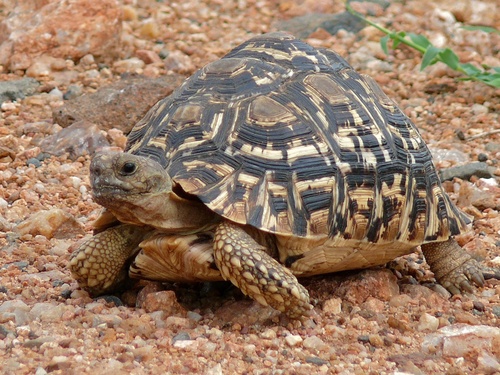
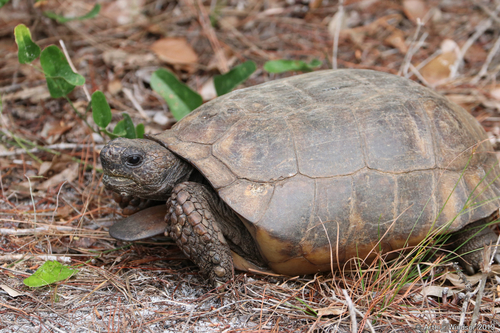
Gopherus polyphemus, commonly called the gopher tortoise, is a terrestrial reptile. It has forefeet well adapted for burrowing, and elephantine hind feet, features that are common to most tortoises. The front legs have scales to protect the tortoise while it burrows. The species' overall color ranges from dark brown to gray-black, with a yellow plastron (the bottom section of the shell). A gular projection is visible on the anterior plastron, where the head emerges from the shell. Sexual dimorphism is clear: male gopher tortoises have a concave plastron, while the female's plastron is flat. In addition, the male's gular projection is generally longer than the female's. The straight carapace length of adult gopher tortoises usually ranges from 6 to 11 inches (15 to 28 cm), with a maximum recorded length of 16 inches (41 cm). The carapace is at least twice as long as it is high. Average adult body mass is 4 kg (8.8 lb), with a total mass range of 2–6 kg (4.4–13.2 lb). This is the only extant species of the genus Gopherus that lives east of the Mississippi River. Conversion of gopher tortoise habitat to urban areas, croplands, and pasture, combined with harmful forest management practices, has drastically reduced the species' historic range. Collecting gopher tortoises for sale, or to use as food or pets, has also severely impacted some populations. The impact of adult tortoise loss is increased by the long time the species takes to reach maturity, and its low reproductive rate. According to the Brevard Zoo website in Melbourne, Florida, current levels of human predation and road mortality alone are high enough to offset any annual addition to the population. Sightings of gopher tortoises have become rare in many areas, and the individuals that are sighted are much smaller than they were in the past. A number of other species also prey on gopher tortoises. Predators of eggs and young gopher tortoises include (but are not limited to) raccoons, coyotes, bobcats, wild boars, striped skunks, eastern spotted skunks, red-tailed hawks, red-shouldered hawks, bald eagles, and multiple snake species: eastern diamondback rattlesnakes, eastern indigo snakes, coachwhips, eastern racers, common kingsnakes, and Florida cottonmouths. Red imported fire ants destroy many eggs and young tortoises. Adult gopher tortoises are less vulnerable to predation, but they are sometimes killed by coyotes, bobcats, and domestic dogs and cats. Nine-banded armadillos may indirectly cause mortality by trapping tortoises in caved-in burrows when the armadillos dig their own dens. A 1980 report found that clutch and hatchling losses often approach 90 percent. In the past, Florida developers could obtain Incidental Take Permits from the Florida Fish and Wildlife Conservation Commission to build in gopher tortoises' natural habitat. Through this permitting process, approximately 83,955 gopher tortoises were incidentally captured and destroyed, and 137,759 acres of gopher tortoise habitat was approved for development. Additional gopher tortoise habitat was lost through the issuance of Special Tortoise Relocation Permits and Standard Tortoise Relocation Permits, but the total acreage of lost habitat and total number of relocated tortoises cannot be estimated for these two permit types. Currently, both gopher tortoises and their burrows are protected under state laws. On July 31, 2007, the Florida Fish and Wildlife Conservation Commission put new permitting rules into effect that require developers to relocate tortoises. Starting April 22, 2009, three permit types have been available in Florida for developers wanting to build on gopher tortoise habitat. Two of these permits allow relocation of gopher tortoises, either to another section of the construction site, or to a recipient site that has been certified by the Florida Fish and Wildlife Conservation Commission. The third permit type allows temporary relocation of tortoises during major utility line installation; after construction is complete, the tortoises are returned to their original habitat. In Florida, some growth stages of invasive snakes, including Burmese pythons, reticulated pythons, Southern African rock pythons, Central African rock pythons, boa constrictors, yellow anacondas, Bolivian anacondas, dark-spotted anacondas, and green anacondas, may eat gopher tortoises. In 1987, human urbanization and various human activities in Mississippi, Louisiana, and Alabama caused dramatic declines in the gopher tortoise population, leading the U.S. Fish and Wildlife Service to list the species as endangered. Even though populations declined in Florida, Georgia, and South Carolina, the species was not listed as threatened in those states at that time. In recent years, however, habitat loss has increased as southern states continue to experience human population growth and expand highway construction. Between 1990 and 2000, the U.S. Southeast saw a 20% increase in human population. One of the most suitable habitats for gopher tortoises is the longleaf pine ecosystem, which provides well-drained, sandy soils that are ideal for the tortoises. Longleaf pine forests have abundant low herbaceous growth and an open canopy with plenty of space, which allows tortoise eggs to incubate properly. Since European settlement, the total area of longleaf pine has decreased by an estimated 96%, which has contributed to an 80% decrease in gopher tortoise population densities. Only 4% of the original longleaf pine forest area remains today. While federal, state, and privately managed forest lands can support large numbers of tortoises, high-density pine plantations can become unsuitable habitat: increased shading leads to a decrease in ground cover species needed by the tortoises. Across the gopher tortoise's range in the U.S. Southeast, there are four large core habitat areas that offer opportunities to protect large areas of tortoise habitat and the coastal plain's overall biological diversity. From west to east, these areas are De Soto National Forest, Eglin Air Force Base, Apalachicola National Forest, and Okefenokee Swamp in Florida. These areas create opportunities to restore forest stands and land areas that host populations of native vertebrate species threatened by habitat fragmentation. Restoring natural disturbance factors, especially fire and flooding, would also help restore native plant and animal communities. If Florida's human population doubles, an estimated 7,000,000 acres (11,000 square miles; 28,000 km²) of land (an area roughly the size of Vermont) could be developed: 3,000,000 acres (4,700 square miles; 12,000 km²) of agricultural land and 2,700,000 acres (4,200 square miles; 11,000 km²) of unused land would be developed. This would increase competition for water resources between humans and native wildlife including the gopher tortoise. The species' low reproductive rate makes it more vulnerable to population declines and extinction as the longleaf pine ecosystem disappears. Human activity causes not just habitat loss, but also habitat fragmentation. Railways act as movement barriers that strongly impact turtles and tortoises including the gopher tortoise. Radio telemetry data shows that gopher tortoises cross railways far less often than expected. Tortoises also have very low success escaping from the area between railway rails after entering it. Tortoises that live near railways (habituated) and those that do not frequently interact with railways (naïve) do not differ substantially in their escape behavior, which suggests prior experience does not improve a tortoise's ability to escape railways it has entered. Trenches dug beneath railways can help tortoises move across railways and escape from between the rails. Since railways are common throughout the gopher tortoise's geographic range, adding railway trenches may improve population connectivity and reduce habitat fragmentation. Gopher tortoises reach sexual maturity between 15 and 20 years of age, with the timeline varying by region. Sexual reproduction involves courtship rituals. During the mating season, which runs from February through September with a peak in May and June, females usually produce only one clutch annually between April and November. Clutch size can range from 1–25 eggs, though most commonly 3–14 eggs depending on female body size, and clutch size is positively correlated with female plastron length. Females lay their clutches in a sandy mound close to the entrance of their burrow. Higher temperatures positively impact reproduction rates and clutch sizes: warmer temperatures stimulate the female's endocrine system, which triggers vitellogenesis (yolk formation). Eggs are incubated underground for 70–100 days. Incubation periods last 80 to 90 days in Florida, and 110 days in South Carolina. Egg sex is determined by incubation temperature in the sandy nest: temperatures above 30 degrees Celsius produce females, while temperatures below 30 degrees Celsius produce males. Before oviposition, eggs remain in the female's uterus for 60 days, where the uterine epithelium supplies water and transports key nutrients to the eggs. Up to 90 percent of clutches may be destroyed by predators (including armadillos, raccoons, foxes, skunks, and alligators) before eggs hatch, and less than 6% of eggs are expected to produce hatchlings that survive at least one year after hatching. As tortoises age, they have fewer natural predators. Egg predation rates do not differ between nests close to burrows and nests further away. Denser soil can also impact hatchlings' ability to emerge, as hatchlings appear unable to dig themselves out of the nest in dense soil.