About Gopherus agassizii (Cooper, 1861)
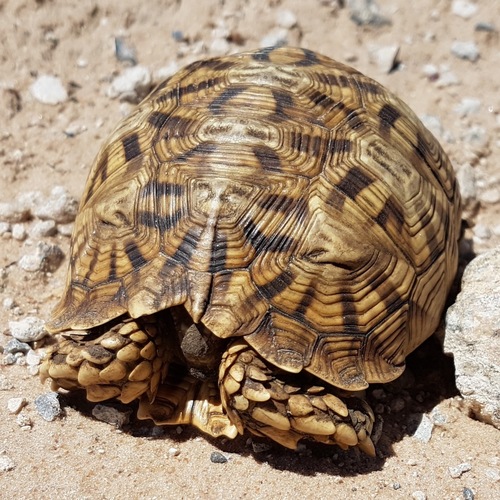
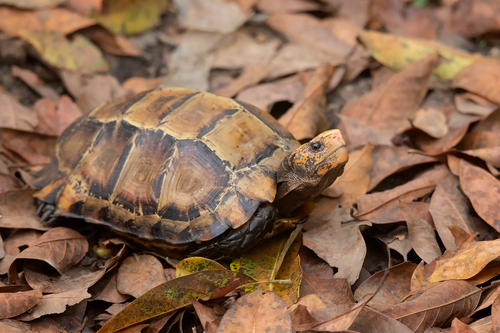
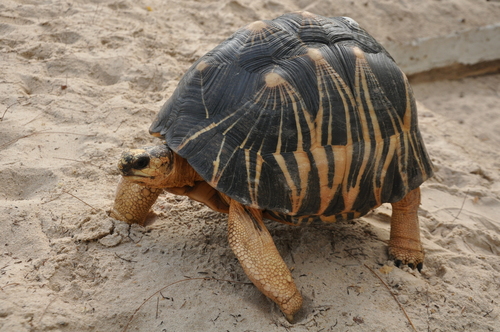
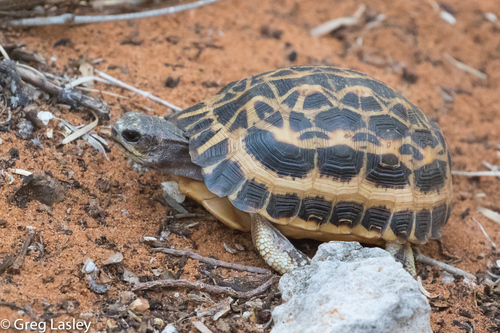
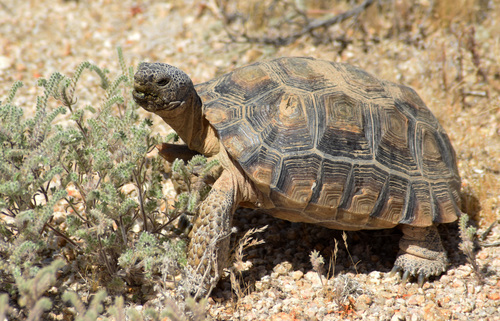
Gopherus agassizii (Cooper, 1861), or Agassiz's desert tortoise, adults reach 25 to 36 cm (10 to 14 in) in shell length, with males slightly larger than females. Males have a longer gular horn, concave lower plastron, and larger tails compared to females. Their shells are high-domed, ranging from greenish-tan to dark brown; the high dome creates lung space that helps the tortoise maintain internal body temperature, a process called thermoregulation. These tortoises grow 10–15 cm (4–6 in) in height, and weigh 8 to 15 pounds (3.5 kg to 7 kg). Their front limbs are flattened for digging and bear sharp, claw-like scales, while their back legs are skinnier and very long. Desert tortoises can live in areas with ground temperatures over 60 °C (140 °F), because they dig burrows to escape the heat, and spend at least 95% of their lives inside these burrows. Burrows also protect tortoises from freezing winter temperatures while they are dormant from November through February or March. The subterranean environment tortoises create in burrows benefits other reptiles, mammals, birds, and invertebrates. Scientists have split the historic desert tortoise grouping into three species: Agassiz's desert tortoise, Morafka's desert tortoise, and Goode's thornscrub tortoise found in northern Sinaloa and southern Sonora, Mexico. An isolated population of Agassiz's desert tortoise occurs in the Black Mountains of northwestern Arizona. This species occupies habitats from sandy flats to rocky foothills. In the Mojave Desert, it has a strong preference for alluvial fans, washes, and canyons, where soils are more suitable for den construction. Its range spans elevations from near sea level to around 1,050 m (3,500 ft), and it can also be found from below mean sea level in Death Valley up to 1,600 m (5,300 ft) in Arizona. It is most common between 300 to 1,050 m (1,000 to 3,500 ft) in elevation. Population density estimates range from less than 8 individuals per km² (21 per sq mi) in southern California sites to over 500 per km² (1,300 per sq mi) in the western Mojave Desert, though most estimates are less than 150 per km² (390 per sq mi). A tortoise's home range generally covers 4 to 40 hectares (10 to 100 acres). In general, males have larger home ranges than females, and home range size increases with higher resource availability and rainfall. Desert tortoises are sensitive to soil type because they rely on burrows for shelter, reducing water loss, and regulating body temperature. Soil must crumble easily for digging and be firm enough to avoid collapse. They prefer sandy loam soils with varying amounts of gravel and clay, and tend to avoid sands or soils with low water-holding capacity, excess salts, or low resistance to flooding. They may consume soil to maintain adequate calcium levels, and may prefer sites with higher calcium content. The spread of off-road vehicles has led to increased human presence in the tortoises' native habitat. These tortoises mate in spring and autumn. During mating season, males grow two large white chin glands that signal breeding condition. A male circles a female, biting her shell along the way, then climbs onto her and inserts his normally hidden white penis into her cloaca near the tail. While mounted, the male may make grunting noises and repeatedly move his front legs up and down in a constant drumming motion. Months after mating, usually in June or July, the female lays a clutch of four to eight hard-shelled eggs about the size and shape of ping-pong balls. Eggs hatch in August or September. Wild female tortoises produce up to three clutches a year depending on climate. Incubation lasts 90 to 135 days, and some eggs overwinter and hatch the following spring. A laboratory experiment found that incubation temperature influences hatching rates and hatchling sex. Incubation temperatures of 27 to 31 °C (81 to 88 °F) produced hatching rates over 83%, while incubation at 25 °C (77 °F) produced a 53% hatching rate. Incubation temperatures below 31 °C (88 °F) resulted in all-male clutches. Average incubation time decreased from 124.7 days at 25 °C (77 °F) to 78.2 days at 31 °C (88 °F). The desert tortoise is one of the few known living tortoise species observed engaging in same-sex sexual intercourse. Same-sex intercourse occurs across many species, and there is no single confirmed explanation for why it happens here; one possible explanation ties it to the social function of gaining and establishing dominance.