About Goodia medicaginea F.Muell.
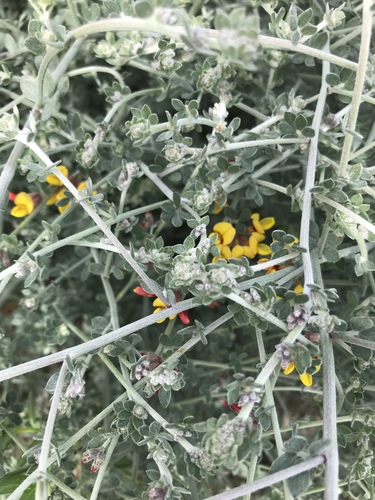
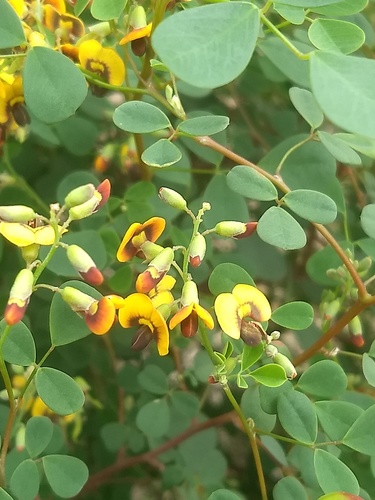
Goodia medicaginea F.Muell. is a shrub that usually grows to a maximum height of 1.5 metres (4 feet 11 inches). It has trifoliate leaves made up of egg-shaped leaflets, which are narrower toward their base. Each leaflet measures 4–32 mm (0.16–1.26 in) long and 2–20 mm (0.079–0.787 in) wide, and the leaf petiole is 5–25 mm (0.20–0.98 in) long. Young leaves are more or less glabrous and dull bluish green in colour. The flowers are mostly yellow with markings ranging from red to purplish-black or brown, arranged in racemes 10–40 mm (0.39–1.57 in) long. Each individual flower is 6–10.5 mm (0.24–0.41 in) long, and grows from a pedicel that reaches up to 5 mm (0.20 in) long. The sepals are 3.0–5.3 mm (0.12–0.21 in) long and joined at the base, and when mature, the three lower sepal lobes are shorter than the sepal tube. This species flowers in August and September, and its fruit is an egg-shaped to oblong pod that is 12–23 mm (0.47–0.91 in) long. This species, commonly known as western golden tip, grows in Western Australia, South Australia, Victoria, and New South Wales. In south-west Western Australia, it grows on granite rocks in granitic soils. In Victoria, it occurs at scattered sites across the southern half of the state. In New South Wales, it is found in mallee communities in areas south of Nymagee.