About Goodenia ovata Sm.
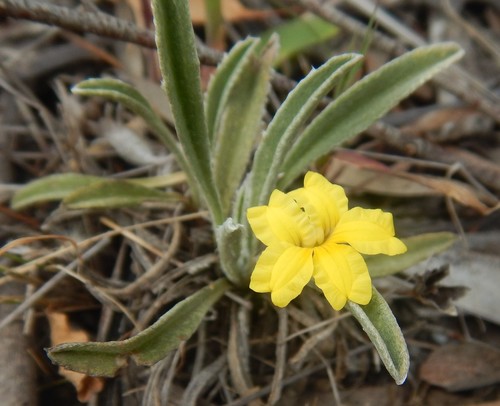
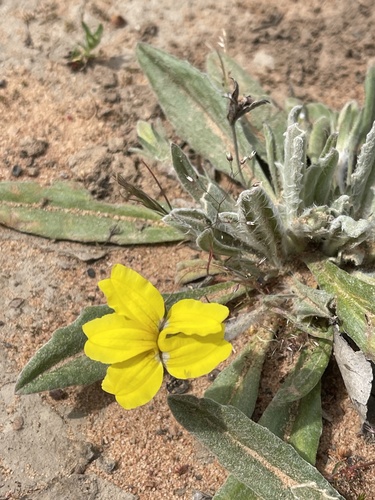
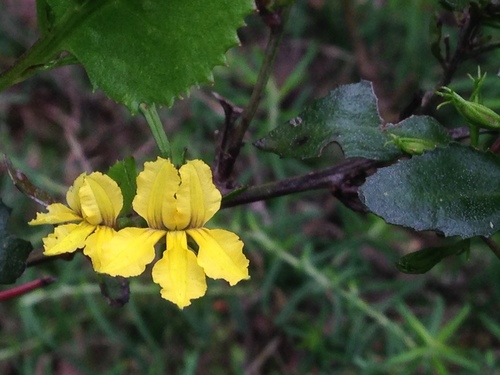
Goodenia ovata Sm. is an erect, ascending to prostrate shrub that usually reaches 2 metres (6 feet 7 inches) in height. It produces sticky foliage that is often coated in a varnished layer. Its leaves are egg-shaped to elliptic, measuring 30 to 80 millimetres (1.2 to 3.1 inches) long and 10 to 40 millimetres (0.39 to 1.57 inches) wide, with toothed margins. Each leaf sits on a petiole up to 30 millimetres (1.2 inches) long. Flowers are arranged in racemes or thyrses up to around 350 millimetres (14 inches) long, growing from a 10 to 40 millimetre (0.39 to 1.57 inch) long peduncle. The inflorescence has leaf-like bracts and linear bracteoles that are 2 to 6 millimetres (0.079 to 0.236 inches) long. Individual flowers grow on a pedicel up to 8 millimetres (0.31 inches) long. Sepals are linear to lance-shaped, 3 to 11 millimetres (0.12 to 0.43 inches) long. Petals are yellow, 10 to 19 millimetres (0.39 to 0.75 inches) long, with lower lobes 5 to 7 millimetres (0.20 to 0.28 inches) long and wings up to 2.5 millimetres (0.098 inches) wide. Flowering occurs year-round, with a peak from October to March. The fruit is a cylindrical capsule 8 to 12 millimetres (0.31 to 0.47 inches) long. This species, commonly called hop goodenia, grows in forest, woodland, and scrub in higher rainfall regions, particularly favoring disturbed areas. It can be found both near the coast and in drier inland areas. Its native range covers south-eastern South Australia, most of Victoria excluding the northern mallee and alpine areas, most of New South Wales, widespread areas of Tasmania, and south-eastern Queensland. It most often grows on medium-nutrient clay soils derived from shale, as well as siltstone and sandstone, in well-drained, partly-shaded locations. It can be found in moist eucalypt forests alongside Themeda australis, growing under trees such as turpentine (Syncarpia glomulifera) or blackbutt (Eucalyptus pilularis). It also occurs in open forest under swamp oak (Casuarina glauca), forest red gum (Eucalyptus tereticornis), thin-leaved stringybark (Eucalyptus eugenioides), or woollybutt (Eucalyptus longifolia). The flowers of Goodenia ovata are pollinated by insects, including native bees, honeybees, and hoverflies. Bushfire kills this plant, which then regenerates from seed after fire passes. In horticulture, this species grows best in partly shaded positions with some moisture. It adapts to a wide range of soil types and tolerates moderate frost. It grows quickly, and is often used as a filler plant in garden plantings. It can be easily propagated from cuttings.